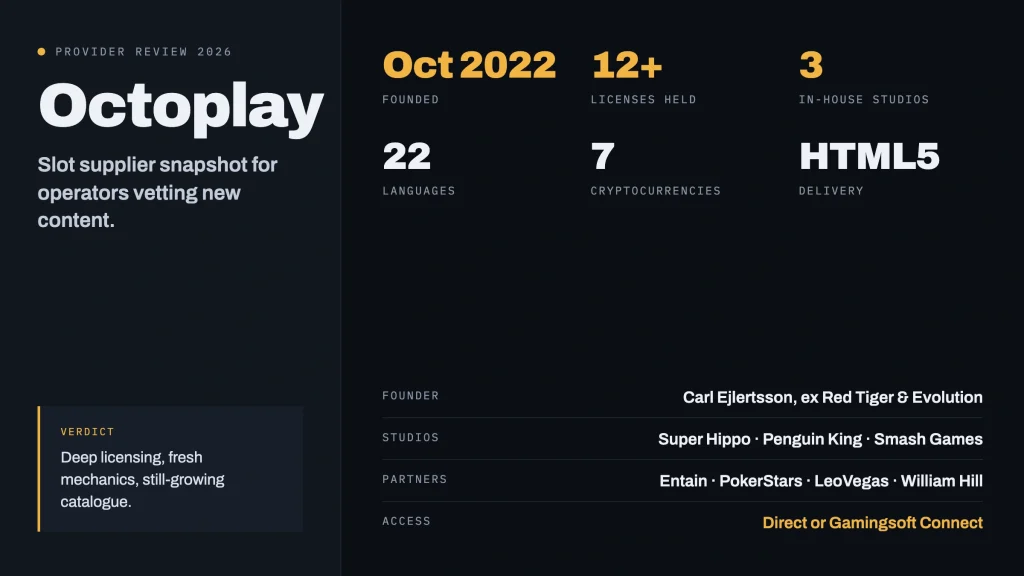
An operator vetting a new slot supplier in 2026 usually runs into one of two problems: either the studio has scale but a thin catalogue of genuinely different mechanics, or it has interesting ideas but almost no regulatory footprint to back them up. Octoplay, founded in October 2022 by former Red Tiger and Evolution executive Carl Ejlertsson, was built to avoid both traps at once. It already holds licenses across Malta, the UK, Sweden, Ontario, Romania, Greece, Denmark and several US states, while running three specialized in-house studios that each chase a different play style. That combination is unusual for a studio still in its first few years. Real regulatory depth this early is the reason Octoplay is worth a closer look before writing it off as just another newcomer.
It won’t be the right call for every lobby, though. An operator that wants the deepest possible catalogue built over a decade will find Octoplay’s library still growing. What follows covers the studio structure and flagship titles, the licensing and technical picture, the commercial access routes, closing with where Octoplay actually earns a place in an operator’s stack.
Quick verdict: Octoplay is best for operators who want newer scatter-pay and cash-game slot mechanics backed by unusually deep multi-jurisdiction licensing for a studio this young, plus near-universal currency support. It’s not ideal for operators who need the largest possible title count today or a studio with a decade-long public track record. Access runs through a direct integration or through Gamingsoft Connect, which already lists Octoplay among its integrated slot providers.
Octoplay’s Position in the Slots Market
Octoplay’s structure is built around specialization rather than a single house style. Three in-house studios each own a distinct play pattern. Super Hippo focuses on scatter-pay mechanics and Penguin King builds cash games; Smash Games, the newest of the three, targets fast-paced VIP-capturing speed games [official, per operator brief]. The company’s own framing is that when a new market trend emerges, it dedicates a studio to it rather than retrofitting an existing team’s output.
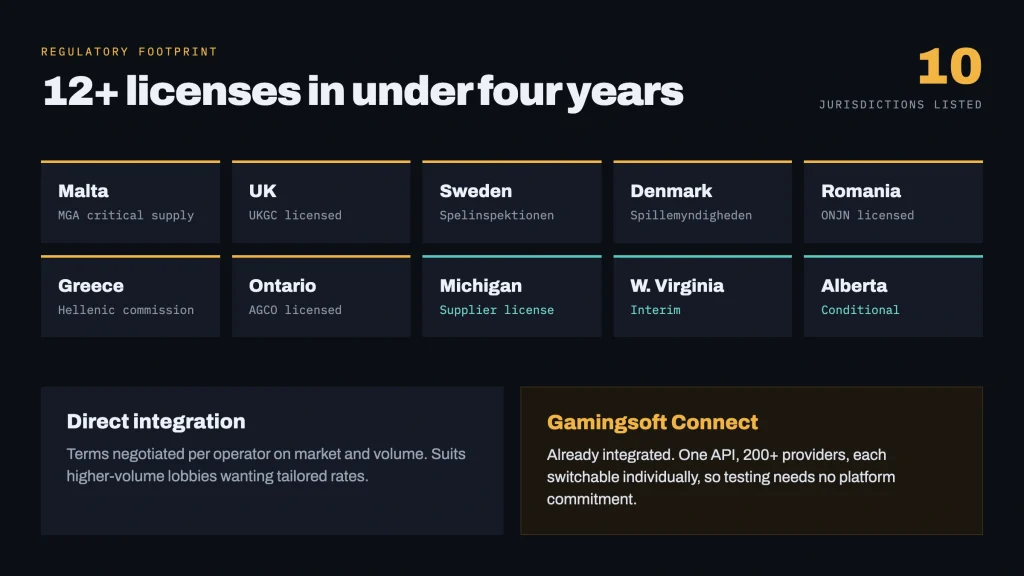
That specialization sits on top of genuinely deep licensing for a studio this young. Octoplay, operating through its Gameshop Limited and Gameshop Malta Limited entities, holds a Malta Gaming Authority Corporate Group Critical Gaming Supply license (MGA/CRP/981/2022), a UK Gambling Commission license (000-061756-R-336614-001) and licenses from Sweden’s Spelinspektionen, Romania’s National Gambling Office, Greece’s Hellenic Gaming Commission, Ontario’s AGCO, and Denmark’s Spillemyndigheden [official company site]. US expansion is already underway too, adding an Internet Gaming Supplier License from Michigan, an interim supplier license in West Virginia and a conditional approval in Alberta.
Founder Carl Ejlertsson’s background at Red Tiger and Evolution shows up in the operator roster more than in any marketing copy. Entain, Novibet, PokerStars, Betfair, LeoVegas, William Hill and Svenska Spel all appear among Octoplay’s listed partners, which is a meaningfully strong client base for a studio not yet four years old.
Game Portfolio and Key Titles
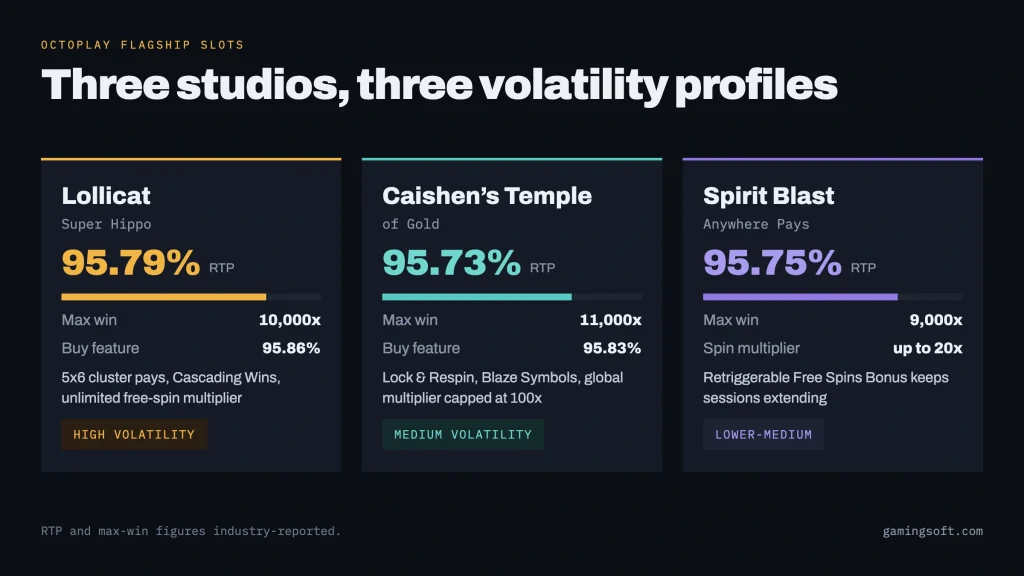
Lollicat anchors the current top tier, running on a 5×6 grid with cluster pays and a Cascading Wins mechanic, and carrying a certified RTP of 95.79%, rising to 95.86% through the buy feature, with a max win of 10,000x the stake [industry-reported]. A candy theme layers Mega and Colossal symbols with an unlimited growing multiplier during free spins, and the game runs high volatility, meaning payouts land less often but hit harder when they do.
Caishen’s Temple of Gold takes a different tack. Built around the Chinese god of wealth, it carries a default RTP of 95.73%, moving to 95.83% with bonus buy, and a max win of 11,000x [industry-reported]. Lock & Respin, Blaze Symbols and Symbol Conversion sit alongside Free Spins, where a global multiplier climbs by 1 with every Lock & Respin trigger, capping at 100x across all wins in that round. Medium volatility keeps the payout rhythm steadier than Lollicat’s high-variance profile.
Spirit Blast rounds out the top three with a lower-medium volatility profile, a 95.75% RTP, and a max win of 9,000x [industry-reported]. Its Anywhere Pays structure supports win multipliers up to 20x on a single spin, with a retriggerable Free Spins Bonus that keeps sessions extending rather than resetting cleanly after one bonus round.
What ties all three together is the Pay Anywhere and cluster-style mechanics that seem to be an Octoplay signature across studios, not just a one-off gimmick in a single release.
Three titles, three studios, three volatility profiles: that spread is the clearest evidence of the specialization strategy at work.
Operators comparing this catalogue against a mega-studio’s back catalogue should weigh mechanic variety against sheer title count, since Octoplay is still building toward that volume.
Technical Infrastructure and Integration
Games run on HTML5, the standard baseline across the market now. Currency support is genuinely broad, spanning essentially every major fiat currency in circulation plus a set of cryptocurrencies including BTC, ETH, LTC, XRP, ADA, BCH and DOGE [official, per operator brief]. Language coverage runs to more than 20 options: English, Danish, Dutch, Estonian, Finnish, French, German, Hindi, Indonesian, Japanese, Korean, Malay, Norwegian, Polish, Brazilian Portuguese, Russian, Romanian, Spanish, Swedish, Turkish, Thai and Ukrainian, with Italian and additional Malay coverage still pending [official, per operator platform].
That’s a currency and language footprint that outpaces most studios still in their first few years of operation. Understanding how a casino game API actually works is still worth doing before integrating any new supplier, since a broad language list doesn’t automatically guarantee low-latency delivery in every one of those markets.
Certification specifics for individual titles, RNG lab affiliations beyond the regulatory licenses already listed, aren’t published in detail on the company’s public materials. That documentation should be requested directly as part of standard due diligence rather than assumed to mirror what a longer-established studio publishes.
Commercial Terms and Access Options
Fixed revenue-share figures aren’t published; terms for a studio at this growth stage typically get negotiated per operator based on market and volume commitments [industry-reported, terms vary]. Any specific rate quoted secondhand should be treated as unconfirmed until it’s in a signed agreement. A proper game provider due diligence pass is worth running here, particularly given how quickly Octoplay’s licensing footprint has expanded in the past year alone.
Octoplay is already available through GamingSoft Connect, which aggregates 200+ providers through a single API integration. This route matters for an operator that wants to add a newer, well-licensed studio without running a standalone negotiation and technical build for just one supplier. Providers can be enabled or disabled individually, so testing Octoplay’s catalogue doesn’t require a broader platform commitment.
Startup operators without an existing content stack, and operators expanding into newly regulated markets where Octoplay already holds a license, both benefit from that lower-friction path. Negotiating contracts with casino game providers directly still makes sense for operators at higher volume who want tailored terms rather than the aggregator default.
Is Octoplay Right for Your Casino?
Octoplay fits operators who want scatter-pay and cash-game slot mechanics from a studio backed by real multi-jurisdiction licensing, rather than betting on an unregulated newcomer or paying a premium for a decade-old mega-studio’s full catalogue.
A few conditions should be true first. The operator needs a market where Octoplay already holds or is actively pursuing a license, since the studio’s regulatory-first approach means coverage gaps still exist outside its current jurisdiction list. Volume commitments matter too, given how commercial terms tend to scale with an operator’s expected activity.
Here’s the honest trade-off: Evolution 并 Pragmatic Play both run far larger catalogues built over many more years, and neither carries the kind of growth risk that comes with a studio still expanding its regulatory map. Volume isn’t where Octoplay competes yet. This bet is that studio specialization, scatter-pay, cash games, speed games, each built by a dedicated team, will differentiate its output as the catalogue grows.
Operators shouldn’t sign on if their lobby strategy depends on having the single largest slot catalogue available today, since Octoplay simply hasn’t built that volume yet. It’s also a weaker fit for operators with zero appetite for a studio still expanding its market coverage, even with the licensing pace Octoplay has shown.
The market angle ties into where Gamingsoft already operates: Asia, Latin America and Africa, where broad currency and cryptocurrency support matter as much as license count in markets still building out formal regulatory frameworks.
常见问题
What games does Octoplay offer?
The current top titles are Lollicat, Caishen’s Temple of Gold and Spirit Blast, produced across three specialized in-house studios. Super Hippo handles scatter-pay games, Penguin King handles cash games and Smash Games handles fast-paced speed games.
Is Octoplay accessible for operators without a direct integration?
Yes. Octoplay is already integrated into Gamingsoft Connect, letting operators enable its catalogue alongside 200-plus other providers through a single API rather than negotiating a standalone deal.
Does Octoplay work for startup operators with no existing content stack?
It’s a solid option, particularly for startups launching in a market where Octoplay already holds a license. Aggregator access removes the need for a separate direct negotiation before content goes live.
How does Octoplay compare to Evolution or Pragmatic Play?
Both of those studios run considerably larger, longer-established catalogues. Mechanic specialization across its studios and an unusually fast regulatory expansion pace for a studio still in its early years are where Octoplay competes instead.
What is the RTP on Lollicat, Caishen’s Temple of Gold and Spirit Blast?
Lollicat carries a 95.79% RTP, rising to 95.86% via bonus buy. Caishen’s Temple of Gold runs 95.73%, rising to 95.83%. Spirit Blast sits at 95.75%, figures reported across independent slot review sites.
Is Octoplay licensed and regulated?
Yes, extensively for a studio this young. It holds licenses from the Malta Gaming Authority, UK Gambling Commission, Sweden’s Spelinspektionen, Romania’s National Gambling Office, Greece’s Hellenic Gaming Commission, Ontario’s AGCO, Denmark’s Spillemyndigheden and several US state regulators.
What currencies and languages does Octoplay support?
Nearly all major fiat currencies plus cryptocurrencies including BTC, ETH, LTC and XRP, alongside more than 20 supported languages spanning European, Asian and Latin American markets.
How do operators access Octoplay through an aggregator instead of a direct deal?
Through Gamingsoft Connect, an operator switches Octoplay’s catalogue on alongside other already-integrated providers, avoiding a second standalone technical build for one supplier.
Operators shouldn’t measure Octoplay purely against the biggest slot studios on catalogue size. Its real differentiator is a genuinely unusual regulatory pace for a young studio paired with mechanic specialization across dedicated teams, and that combination is worth weighing on its own terms rather than by title count alone.