An operator expanding into Southeast Asia had four payment providers integrated. Each was connected directly to the platform backend, built and tested in separate development cycles. Adding a fifth provider required a new integration sprint, a full QA pass, and another four weeks before it was live. Meanwhile, their deposit failure rate in Indonesia was running at 28%. The problem was not which providers they had chosen. It was that every transaction went to a single designated provider for each payment type, with no fallback logic, no dynamic routing, and no visibility into why specific transactions were failing at that rate.
Six months after moving to a payment orchestration layer, the same operator had seven active providers, deposit approval rates above 87% in their primary markets, and a payment team that could update routing rules in a day. The underlying provider roster was similar. What changed was the coordination layer sitting above it.
That gap, between providers integrated one by one and providers managed through a unified orchestration system, is where most of the performance difference between comparable operators actually comes from.
Why Direct Provider Integrations Break Down at Scale
The single-integration model works well enough at the start. One PSP, one payment flow, manageable complexity. Yet the cracks appear as soon as an operator tries to serve multiple geographies, add local payment methods, or handle volume spikes that stress a single provider’s infrastructure.
Each direct integration is built and maintained separately. Adding a provider means a new development cycle. Removing one means cleanup work across the payment codebase. When a provider goes down mid-event, the team scrambles to reroute traffic manually, because the routing logic is not centralized anywhere; it is baked into how the integrations were built. That capacity is rarely there when a major match is running and deposits are spiking.
The data problem is just as significant. Approval rates are tracked per provider, but not in a single place that connects them. An operator might know that Provider A has a 71% approval rate on Malaysian cards, whereas Provider B handles the same card type at 84%, yet without a unified view that surfaces this comparison automatically, the routing decision never gets made. Transactions are sent to A by default. The 13-point gap sits there, invisible, for months.
As markets are added, the integration debt compounds. Southeast Asia alone has materially different dominant payment methods by country: bank transfers in Thailand, e-wallets in Malaysia, QR-based payments in Vietnam, a mix of local methods in the Philippines. Building and maintaining direct integrations for each creates a payment infrastructure that grows in proportion to market count rather than in proportion to business logic. The payment codebase becomes the slowest-moving part of the platform.
What a Payment Orchestration Layer Actually Does
Payment orchestration is a centralized management system that sits between the operator’s platform and its payment providers. Instead of connecting each PSP directly, all provider integrations are handled through the orchestration layer, which then exposes a single interface to the platform above it.
Transactions are evaluated at the orchestration layer before they reach any provider. The system reads the transaction characteristics: payment method, currency, card BIN range, player geography, and deposit size. It then applies routing rules to select the appropriate provider. Those rules are configured centrally and can be updated without a new deployment. Adding a provider means connecting it to the orchestration layer once; after that, it becomes available for routing across any market or payment method it supports.
The shift in how payment infrastructure is managed is substantial. Rather than treating each provider relationship as a separate system, the orchestration layer treats them as a pool of resources to be allocated intelligently. Providers are selected based on which one is most likely to succeed with a specific transaction, not which one happens to be assigned to that payment type by default. Performance data is aggregated across the pool, so the comparison between providers is visible in one place and routing decisions can be updated based on what the data shows.
The iGaming platform architecture that most naturally supports orchestration is one where the payment layer is modular: the orchestration system can be connected or replaced without rebuilding the platform. Operators who built their payment infrastructure as a core part of the platform, rather than as a separate layer, often find that moving to orchestration requires a more significant architectural change than the business case would initially suggest.
How Routing, Fallback, and Retry Logic Drives Deposit Approval Rates
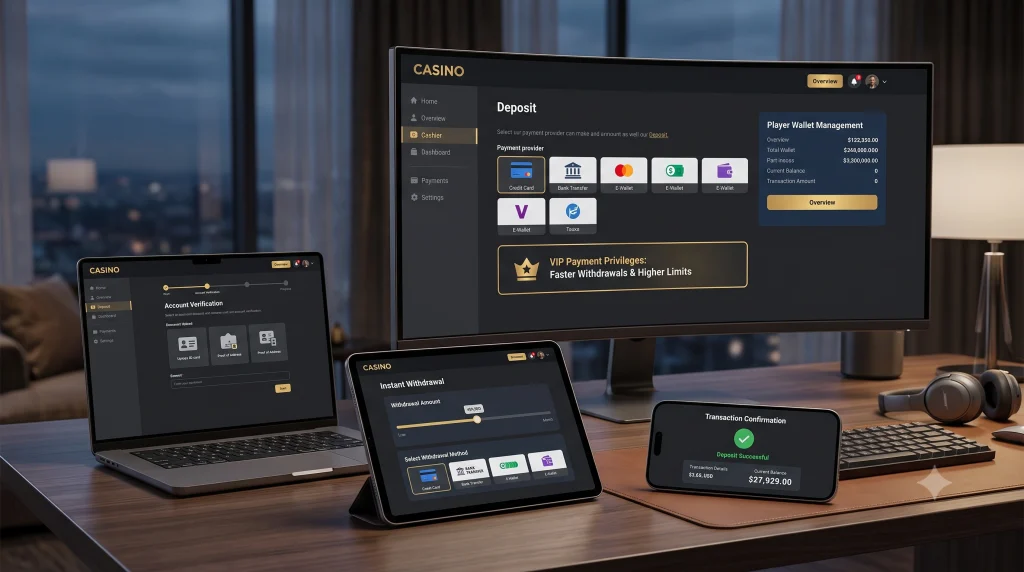
A deposit approval rate is not determined by which payment methods are offered. It is determined by which providers process those methods and what happens when a transaction is declined. In a direct-integration setup, a decline from the primary provider is usually a final answer. The player sees an error. The deposit is abandoned. Most single-PSP setups have no answer to this.
Orchestration changes this dynamic through routing, fallback, and retry logic applied in sequence. Before a transaction reaches any provider, routing rules direct it to the one most likely to succeed based on transaction characteristics. After a decline, fallback logic checks whether a retry through a different provider is appropriate given the decline code returned. Retries are triggered only when the reason for failure suggests a different path would succeed. A card declined because the acquiring bank has no relationship with the issuing bank will often be accepted by a different acquirer. A card declined for insufficient funds will not.
The improvement in approval rates from this approach is measurable and consistent. In card-heavy transaction flows, moving from a single-provider setup to multi-provider routing with intelligent fallback typically recovers 8 to 20 percentage points of transactions that would otherwise have been lost. At any meaningful deposit volume, that recovery represents significant revenue. The casino payment routing mechanics underlying this improvement are available regardless of orchestration, but they are much harder to implement and maintain without a centralized layer managing the routing decisions.
Decline code handling is where the quality of the orchestration system becomes most visible. Providers vary in how granular their decline codes are: some return specific reasons, whereas others return only generic failure codes. The more precise the decline data, the more accurately retry logic can be calibrated. Operators evaluating orchestration solutions should look at how provider decline data is surfaced and whether routing logic can reference it. A system that treats all declines identically cannot implement intelligent retry regardless of how sophisticated the routing rules above it are.
Withdrawal Speed, Risk Management, and Compliance
Withdrawals are handled differently from deposits in most payment infrastructures, though the orchestration benefits apply equally. Without centralized management, payouts are queued by payment method and routed to the provider assigned to that method, with no dynamic selection based on which payout path is fastest or lowest-cost at that moment. Faster payout paths go unused when the assigned provider is slow.
Through orchestration, withdrawal routing applies the same logic as deposit routing: the payout is directed to the fastest available provider for that currency and geography, within the operator’s risk and compliance constraints. Manual processing steps that exist because the payment team cannot see all payout queues simultaneously are reduced, as the orchestration layer surfaces the status of all pending payouts in one place. Players who receive faster withdrawals are measurably more likely to deposit again. That connection between payout speed and retention is well-documented, yet the infrastructure investment to improve it is often delayed because it requires touching multiple payment integrations rather than a single configuration.
Risk management is handled through the same orchestration layer rather than separately. Transaction risk scores are applied before routing decisions are made, so high-risk transactions are directed to providers with stricter authentication requirements while low-risk transactions from verified players move through lower-friction paths. Flags are raised on suspicious transaction patterns across providers, in one place, rather than managed separately within each integration. The chargeback prevention work that depends on routing high-risk card transactions through 3DS-enforcing providers is significantly more tractable when routing is centralized.
Compliance across multiple markets is the other major operational benefit. Each jurisdiction has its own requirements around payment method availability, transaction limits, and KYC triggers. Without centralized management, compliance rules are embedded in individual integrations and difficult to audit. Through an orchestration layer, market-specific rules are configured centrally and enforced consistently. Adding a new jurisdiction means configuring its compliance parameters once, rather than updating every provider integration separately.

When Orchestration Makes Sense and What to Look for in a Solution
The case for payment orchestration grows with transaction volume and market count. For an operator processing a few hundred deposits per day in a single market through two or three providers, the complexity of orchestration may not be justified yet. For an operator running across four or more markets, managing six or more payment methods, and processing volume that makes per-point approval rate improvements meaningful, the infrastructure investment returns relatively quickly.
There are two paths to orchestration capability. Building it in-house means controlling every aspect of the routing logic and provider relationship management, though the development cost is high and the ongoing maintenance is significant. The payment API integration work alone, across multiple providers with different technical specifications, represents months of development time before any routing logic is built on top. The second path is slower and more expensive than it appears at the start.
Using an orchestration platform, whether as a standalone layer or as part of a broader iGaming platform, reduces the integration work to connecting to one system rather than to each provider separately. Providers can be added to the pool without new development on the operator side. Routing rules are configured through an interface rather than in code. The tradeoff is less control over specific implementation details, though in practice most operators do not need that level of customization. The data analytics that make orchestration genuinely useful, including approval rate tracking, provider performance comparison, and decline code analysis, are often included with orchestration platforms and take significant effort to build independently.
The most useful evaluation criteria when selecting an orchestration solution are: how many providers are pre-integrated and whether those include the specific local methods needed for target markets, how granular the routing rule configuration is, what decline data is returned per transaction, how performance analytics are presented, and what the SLA looks like for provider outages. An orchestration layer that abstracts provider selection but provides no visibility into why routing decisions were made is difficult to optimize over time. The value compounds most when routing decisions can be reviewed and updated based on what the performance data shows.
Frequently Asked Questions
What is payment orchestration in iGaming?
Payment orchestration is a centralized layer that manages connections to multiple payment providers, routes transactions to the appropriate provider based on configurable rules, handles fallback and retry when a transaction is declined, and aggregates performance data across all providers into a single view. It sits between the operator’s platform and the payment provider ecosystem, replacing a collection of direct point-to-point integrations with a single managed system.
At what stage should an operator invest in payment orchestration?
The investment typically makes sense once an operator is managing payments across three or more markets, running more than four active payment methods, or experiencing approval rate problems that a single provider cannot solve on its own. Operators who are expanding into markets with fragmented local payment ecosystems, Southeast Asia in particular, often find orchestration becomes necessary faster than expected, because the integration overhead of maintaining direct connections to multiple local providers quickly outpaces what a small payment team can manage.
How much can orchestration realistically improve deposit approval rates?
The improvement depends on the starting point. Operators moving from a single-PSP setup to multi-provider orchestration with intelligent routing typically see approval rate gains of 8 to 20 percentage points on card transactions in markets where multiple viable PSPs exist. The gains are smaller for e-wallet and bank transfer methods, where routing variables are fewer, though the availability of fallback options still provides meaningful resilience when a primary provider experiences downtime.
Does payment orchestration replace the need for a payment gateway?
Orchestration and gateway are not the same function. A payment gateway handles the technical transaction processing between a merchant and a PSP. An orchestration layer manages which PSP is used for each transaction and coordinates across multiple gateways or PSPs simultaneously. An operator typically needs both: the gateway handles the processing, the orchestration handles the routing and provider management. Some orchestration platforms include gateway functionality; others connect to existing gateways without replacing them.
How does orchestration help with compliance across multiple markets?
Market-specific compliance requirements, including transaction limits, restricted payment methods, KYC triggers, and local currency handling, are configured centrally in the orchestration layer and applied automatically based on where a transaction originates. This means adding a new jurisdiction involves updating one set of configurations rather than modifying every provider integration separately. It also makes compliance auditing more straightforward, since all rules are visible in one place rather than distributed across individual integrations.
What is the biggest operational risk of not having orchestration?
Provider concentration risk. An operator without orchestration is dependent on each individual PSP’s uptime, approval rates, and operational reliability, with no automated way to shift volume when one provider degrades. During high-stakes events, including major sporting fixtures and casino promotions, this dependency is most costly, because traffic peaks are precisely when provider stress is highest and the consequences of payment failures are most visible to players.
Payment orchestration is not a feature added on top of a functioning payment setup. For operators managing meaningful transaction volumes across multiple markets and methods, it is the infrastructure that makes payment management possible at all. The approval rate improvements, the withdrawal speed gains, and the compliance handling are outcomes of having a coordination layer that can make routing decisions faster and more precisely than any manual process can match.
Industry events are where ideas turn into partnerships, and Gamingsoft is a consistent presence at the most important conferences on the global iGaming calendar. We attend these gatherings to stay close to the operators, developers, and regulators shaping the industry. Many of our strongest partnerships began with a conversation at an event. Our team is always ready to discuss game aggregation deals, market challenges, or anything else on your mind. Visit gamingsoft.com and connect with our business development team today.