A white-label operator launching a sportsbook aimed at Vietnamese, Thai, Indonesian bettors has a narrower shortlist than it looks at first. Global odds giants like Sportradar or Kambi are built for regulated European operators with deep compliance budgets, not necessarily for a turnkey Asian-facing brand that needs 40-plus currencies and 13 languages, plus a reseller structure ready on day one.
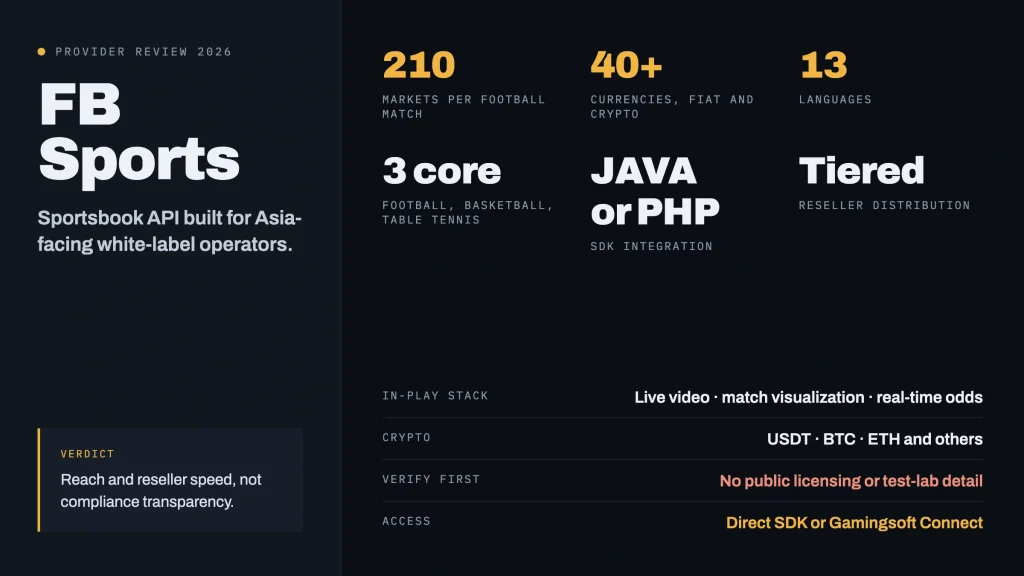
FB Sports, also marketed as New体育, pitches directly at that gap: up to 210 betting markets on a single football match, real-time video streaming, and a tiered distribution system built for operators running white-label sportsbook sites specifically. That’s a genuinely different starting point than a compliance-first European odds feed, and it changes what an operator should actually be checking before signing on.
It won’t suit everyone. Operators that need a fully documented regulatory trail for a licensed European market, or that plan to publish detailed public compliance disclosures, will run into a real gap here. What follows covers the betting markets on offer, the technical delivery model, what is and isn’t publicly disclosed about certification, and where FB Sports realistically fits in an operator’s stack.
Integrate FB Sports Sportsbook Now
Quick verdict: FB Sports is best for white-label and turnkey sportsbook operators targeting Southeast Asian and broader emerging markets who need broad currency and language coverage plus fast-moving in-play markets. It’s not ideal for operators building a fully regulated European or North American book that requires a transparent, publicly documented licensing trail. Access runs through a direct API integration with a JAVA or PHP SDK, or through a broader aggregator connection that folds sportsbook data in alongside casino and live dealer content already on the platform.
FB Sports’ Position in the Sportsbook Market
FB Sports operates in a specific corner of the sportsbook API market: providers built for turnkey white-label, a segment of Asian-facing iGaming. That’s a distinct business model from Sportradar or EveryMatrix’s OddsMatrix division, which sells primarily to regulated, license-first operators across Europe and North America. FB Sports instead pitches its tiered distribution system directly at resellers and white-label brands who need to launch fast rather than navigate a multi-jurisdiction compliance process first.
The company’s own materials describe a layered reseller structure meant to let partners stand up a sportsbook business quickly, backed by what it calls a top-tier trading team managing the odds book in real time. That framing matters for how an operator should read the rest of this review. FB Sports competes on speed and market depth per event, plus reach into currencies and languages that larger European-focused suppliers often treat as secondary.
Against a name like DB Gaming, a comparable Asia-facing API provider covering similar white-label casino and sportsbook territory, FB Sports differentiates mainly on its sports-first focus and its claimed 210-market ceiling per football fixture, though independent, third-party verification of that figure is limited. The broader question of how to choose the right sportsbook software provider applies just as much in this corner of the market as it does when comparing regulated European suppliers.
Betting Markets and Product Coverage
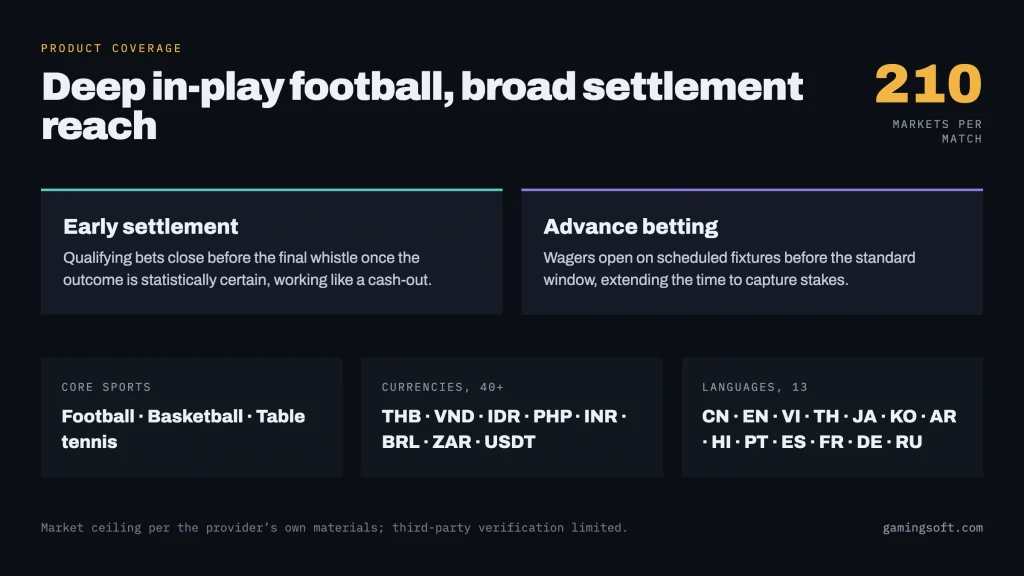
Football, basketball, and table tennis sit at the center of FB Sports’ offering, based on the provider’s own product materials. Market depth runs deepest on football. The company cites as many as 210 distinct betting options on a single match, spanning full-time results, handicaps, and totals, plus a wide range of in-play markets layered on top of real-time video coverage.
Two features stand out.
Early settlement lets an operator’s platform close out qualifying bets ahead of a match’s natural conclusion once an outcome becomes statistically certain, functioning similarly to a cash-out mechanism seen on larger regulated books. Advance betting, meanwhile, lets bettors place wagers on scheduled fixtures ahead of the standard betting window opening, which extends the window an operator has to capture stakes on popular events.
What’s less clear from public materials is granular settlement speed or dispute-resolution documentation, the kind of operational detail that regulated sportsbook suppliers typically publish in service-level agreements. Operators evaluating FB Sports should request that documentation directly rather than assume it matches what a Sportradar or Kambi contract would include.
Live video and animated match visualization back the in-play product, delivered alongside real-time odds updates. That combination is fairly standard across Asia-facing sportsbook API vendors now, though it remains a meaningful upgrade over text-only odds feeds for operators building an engagement-heavy in-play product. The wider set of integrations a modern sportsbook platform needs extends well past odds and streaming, and it’s worth mapping FB Sports against that fuller checklist rather than judging it on markets alone.
Technical Infrastructure and Integration
Integration runs through a JAVA or PHP SDK, which the provider markets as broadly compatible across common backend stacks used by white-label operators in this segment. That’s a narrower technical menu than some Western aggregators offer, but it matches the stack most turnkey Asian sportsbook platforms are already built on.
Currency support is unusually broad. FB Sports lists more than 40 currencies: major fiat options such as USD, EUR, and GBP; a long list of regional currencies including THB, VND, IDR, PHP, INR, BRL, and ZAR; plus cryptocurrency settlement through USDT, BTC, ETH, and several other coins. Language coverage runs to 13 options. That list includes Simplified and Traditional Chinese, English, Vietnamese, Japanese, Thai, Arabic, German, Spanish, French, Hindi, Korean, Portuguese, and Russian.
Here’s the gap worth naming directly: FB Sports’ public-facing site doesn’t list specific regulatory certifications or licensing bodies, and there’s no mention of third-party testing lab affiliations either, the way Sportradar or Kambi lay them out on their own sites.
That doesn’t necessarily mean none exist, but it does mean an operator can’t verify compliance status from public materials alone. Confirming this directly with FB Sports and folding it into a broader game provider due diligence process matters more here than it would for a supplier with a public license register entry.
Many operators in this segment lean on a Curacao gaming license at the platform level even when individual data suppliers don’t publish their own certifications, so it’s worth clarifying where that compliance responsibility actually sits.
Commercial Terms and Access Options
FB Sports doesn’t publish standardized commercial terms, and pricing in this segment of the market typically gets negotiated per reseller tier rather than posted publicly. Any revenue-share or fee figure quoted secondhand should be treated as unconfirmed until it comes directly from FB Sports.
The tiered distribution system the company describes suggests commission or margin structures that scale with a reseller’s downstream activity, which is standard for this corner of the white-label market but not something operators should assume without a signed agreement.
For operators already running or planning a turnkey casino build, the same white-label casino onboarding checklist logic applies to sportsbook data, and folding it into that same stack is often more practical than through a standalone FB Sports integration.
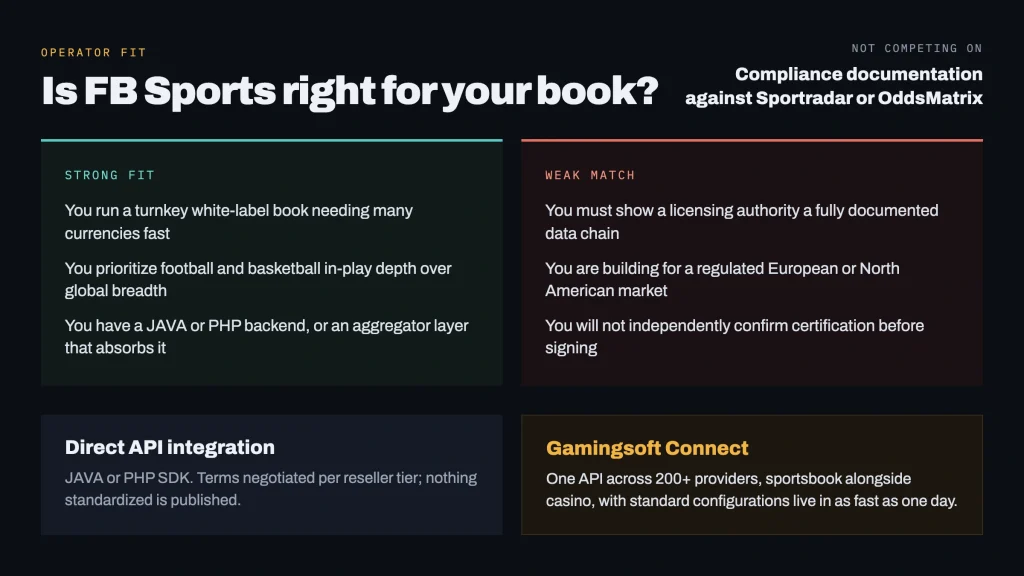
Gamingsoft Connect aggregates 200+ providers through a single API integration. Sportsbook operators expanding into casino verticals and casino-first operators adding sports content can both enable or disable individual providers without a separate technical build for each one.
That matters most for startup operators without an existing provider network. Reviewing the fundamentals of how a sports betting odds feed actually works before signing with any single supplier, FB Sports included, helps an operator ask sharper questions about settlement speed and market depth, plus data latency, rather than taking a vendor’s own marketing claims at face value.
Gamingsoft’s multi-currency and multi-language configuration, plus its CRM and player retention tooling, cover ground that a pure odds API doesn’t address on its own, and a standard Gamingsoft Connect setup can go live in as fast as one day for standard configurations.
Launch Your White Label Casino Faster
Is FB Sports Right for Your Sportsbook?
FB Sports is the stronger choice for white-label and turnkey operators targeting Southeast Asia and other emerging, crypto-friendly markets who need deep in-play football coverage and broad currency support without a lengthy licensing negotiation attached to the content deal itself.
A few conditions should be true first. The operator needs a Java- or PHP-compatible backend, or an aggregator layer that absorbs that requirement instead. Market focus matters too: an operator building specifically toward a European or North American regulated license should weigh the lack of public certification details as a real constraint, not a minor gap.
The honest trade-off against Sportradar or EveryMatrix’s OddsMatrix: both of those suppliers publish far more detailed compliance and data-quality documentation, and they’re built for operators who need to show regulators exactly where their odds data comes from. FB Sports isn’t competing on that transparency, it’s competing on reach into currencies and languages, plus reseller structures that fit the turnkey Asian market more directly.
Strong fit: operators running a 包网-style white-label sportsbook that needs fast setup across many currencies and languages at once.
Also a strong fit: operators prioritizing football and basketball in-play depth over the widest possible global sports catalogue.
Weak match: operators that must present a fully documented regulatory chain to a licensing authority, since that documentation isn’t public here.
Not recommended: for operators unwilling to independently confirm certification status before signing, given how little of it is disclosed up front.
The market angle tracks closely with where Gamingsoft already operates: Asia, Latin America, and Africa, where currency flexibility and fast reseller onboarding tend to matter more to operators than a polished compliance page.
Frequently Asked Questions
What sports does FB Sports cover?
Football, basketball, and table tennis form the core of the product, with football carrying the deepest market count at up to 210 options per match, according to the provider’s own materials.
Is FB Sports accessible for operators without a direct API deal?
Yes, in practice. Operators who prefer not to run a standalone FB Sports integration can fold sportsbook content into a broader aggregator such as Gamingsoft Connect alongside 200-plus other providers through one API.
Does FB Sports work for startup or first-time white-label operators?
It’s built with that segment in mind. The tiered distribution model is aimed specifically at resellers and turnkey operators launching quickly rather than established brands with existing direct-integrated content stacks.
How does FB Sports compare to Sportradar or EveryMatrix’s OddsMatrix?
Both of those suppliers publish considerably more compliance and data-sourcing documentation and serve regulated European and North American operators as a core market. FB Sports competes on currency breadth and language coverage, plus reseller-friendly onboarding for Asia-facing white-label operators instead.
What currencies does FB Sports support?
More than 40: major fiat currencies like USD, EUR, and GBP; regional currencies across Asia, Latin America, and Africa; plus cryptocurrency settlement through USDT, BTC, ETH, and several other coins.
Is FB Sports licensed and regulated?
The provider’s public site doesn’t list specific licensing bodies or certification details. Operators should request this information directly from FB Sports as part of standard due diligence rather than assume a particular regulatory status.
What makes early settlement and advance betting useful for operators?
Early settlement lets qualifying bets close before a match ends once the outcome is statistically clear, similar to a cash-out feature. Advance betting extends the window for placing wagers on scheduled fixtures ahead of the usual opening time, which can capture stakes earlier in an event’s lifecycle.
How do operators access FB Sports through an aggregator instead of a direct integration?
Through a platform like Gamingsoft Connect, an operator can enable FB Sports’ sportsbook content alongside other already-integrated providers, avoiding a second standalone JAVA or PHP integration built just for one supplier.
Operators shouldn’t evaluate FB Sports as though it were competing head-to-head with a fully regulated European odds supplier, because that isn’t the market it’s built for. Its real value sits in currency reach and language coverage, plus reseller speed for the turnkey Asian sportsbook segment. That’s the lens worth applying before any integration decision.