Every quarter, a Gamingsoft account manager fields some version of the same question from an operator sizing up its next launch: “Just tell me which country to pick.” There’s never a clean one-line answer. Behind that question sit five dashboards, five betting cultures, and five regulatory pictures that have almost nothing in common with each other, and the country carrying the biggest headline number isn’t automatically the safest place to put a launch budget.
This piece puts all five side by side: South Korea, China, India, Vietnam, and Myanmar, the five countries accounting for the overwhelming majority of sportsbook activity recorded in Gamingsoft’s own transaction data across May, June, and July 2026. It looks at how each one actually performed within that period, what actually drives betting behavior on the ground behind those numbers, and closes with a direct read on how the five compare.
How Each Country Performed: The Numbers
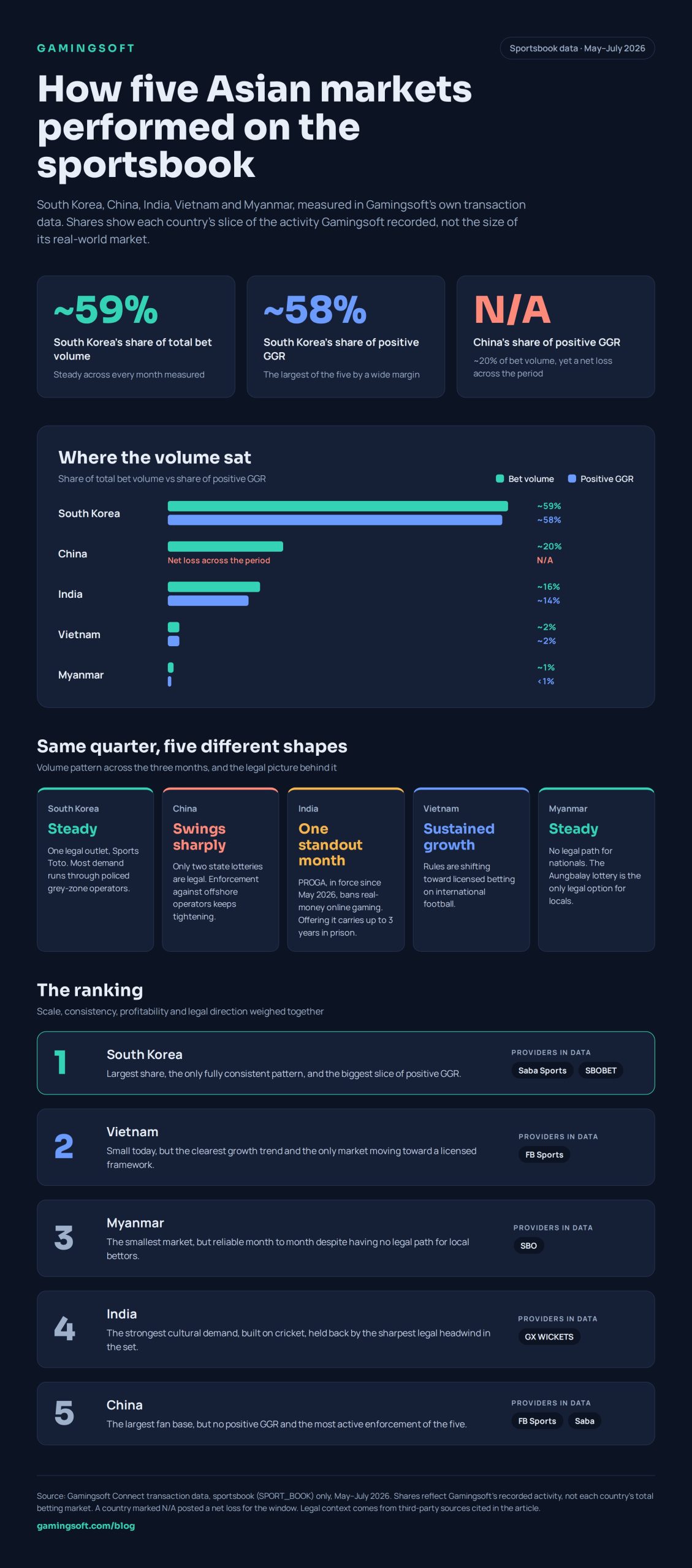
Start with the numbers, since they set the frame for everything that follows. Across the three months measured, total bet volume and GGR in Gamingsoft’s sportsbook data are heavily concentrated in a handful of markets, and the gap between the top country and the rest isn’t subtle.
Sportsbook total bet volume and GGR by country, Gamingsoft data, May – July 2026
| Country (currency) | Share of total bet volume | Share of positive GGR | Volume pattern across the quarter |
|---|---|---|---|
| South Korea (KRW) | ~59% | ~58% | Steady and consistent across every month measured |
| China (CNY) | ~20% | N/A | High volume, but swings sharply between months |
| India (INR) | ~16% | ~14% | High volume, but built overwhelmingly around one standout month |
| Vietnam (VND) | ~2% | ~2% | Smaller scale, but a genuine, sustained growth trend |
| Myanmar (MMK) | ~1% | <1% | Smaller scale, but steady month to month |
How to read this table: Share figures reflect each country’s slice of the total sportsbook activity recorded in Gamingsoft’s own transaction data in the three-month window, not an estimate of that country’s total real-world betting market. A country marked N/A on GGR posted a net loss across the period, so a share of the positive-GGR pool doesn’t apply to it. Volume pattern describes how evenly each country’s activity was spread across the three months, since a country that arrived at its total largely through one unusual month tells a different story from one that built the same total steadily over the quarter.
South Korea’s position here does most of the explaining on its own: it’s not just the largest of the five markets, it’s the only one that combines a large share with a fully consistent pattern across all three months.
China and India both post real scale, but both got there in a lumpier way, and that difference matters as much as the headline percentage once an operator starts thinking about what happens in month four.
Vietnam and Myanmar sit at the opposite end on a raw scale, small enough that neither would top the ranking on its own, though for different reasons, worth returning to once the cultural and regulatory picture is on the table too.
Five Countries, One at a Time
Behind every number in that table is a country with its own relationship to sports, its own legal framework, and its own reasons people bet the way they do. None of the five look alike once you get past the currency symbol, so each one gets its own read below before the pieces come back together.
South Korea: The Strongest Data Signal of the Five
South Korea leads on the key measures: the largest share of total bet volume (~59%), the largest share of positive GGR (~58%), and the only fully steady pattern across all three months measured. That steadiness isn’t an accident. South Korea bets the way it lives online: constantly, socially, and predominantly through mobile.
The main legal domestic outlet is Sports Toto, a government-run channel, but the demand that actually shows up in Gamingsoft’s own data runs mostly through operators in a grey zone that Korean authorities actively police. What fuels the demand is a packed, year-round calendar: the KBO baseball league, the K League, and a genuinely massive esports scene built around the LCK, watched and bet on in groups rather than alone.
That habitual, year-round demand is what shows up in Gamingsoft’s numbers as the steadiest bet volume of the five countries measured and the largest share of positive GGR.
China: Largest Population, Most Volatile Data
China carries the second-largest share of total bet volume (~20%), but posted no positive GGR across the period measured, and its month-to-month pattern swings sharply rather than holding steady. That volatility fits the market being measured.
China has the largest sports-fan population in this comparison and the most tightly closed market of the five. Mainland China permits only two state-run lotteries, the China Sports Lottery and the China Welfare Lottery; every other form of sports betting, online or offline, is illegal, and Beijing’s enforcement campaign against offshore operators has become more targeted rather than less heading into 2026 (GamblersArea).
None of that has eliminated demand. Instead, it has pushed much of it underground, into a persistent offshore betting economy that is difficult to measure and continues to find ways around each new round of blocking. That underground, hard-to-track nature of Chinese demand lines up with what shows up in Gamingsoft’s own data too: real scale (~20% of total bet volume) that never resolved into a profitable quarter (GGR marked N/A), swinging sharply from one month to the next rather than settling into a steady pattern.
A dedicated China sportsbook opportunity guide is in development as part of this series.
India: Huge Demand, Built Around One Standout Month
India’s ~16% share of total bet volume and ~14% share of positive GGR look strong on paper, but the pattern behind them is lumpy rather than steady. Most of that volume landed in a single standout month rather than spreading evenly across the quarter.
That pattern tracks a market under real pressure. India carries the most passionate sports betting culture in this set, built almost entirely around cricket, and it has just experienced the sharpest legal shock of the five.
The Promotion and Regulation of Online Gaming Act, passed in August 2025 and in force since May 1, 2026, imposes a blanket national ban on real-money online gaming, which on a plain reading of its broad definition of an online money game also reaches cricket betting, with penalties for a first offense of up to three years in prison, a fine of up to ₹1 crore, or both (CricketPrediction).
Enforcement is aimed at operators, advertisers and payment intermediaries, and a December 2025 survey of 1,000 former real-money gamers in Delhi NCR found offshore platform usage rising from 68.3% to 82% after the law was passed. It’s a small, regional, self-reported sample, yet it hints at how deep the underlying demand runs even under direct legal pressure.
That same pressure shows up directly in the data: India’s ~16% share of total bet volume was real, but it landed overwhelmingly in one standout month rather than holding steady, the shape you’d expect from demand that has to find a new channel every time an old one gets shut down.
A dedicated India sportsbook opportunity guide is in development as part of this series.
Vietnam: Small Today, the Clearest Growth Trend
Vietnam holds a modest ~2% share of both total bet volume and positive GGR, but unlike China or India, that total was built through a genuine, sustained climb rather than a single spike. The regulatory backdrop explains why.
Vietnam is the outlier of the group, and in a good way. Where every other country here is holding the line or tightening it, Vietnam is moving toward a licensed framework. Decree 06/2017 is still treated as the governing instrument in recent published sources, but a draft decree would open a pilot for international football betting with up to three licensed enterprises, a daily wagering cap of VND 10 million per player and mandatory personal identification, covering competitions run by FIFA, UEFA and the AFC along with the top leagues of England, Spain, Italy, Germany and France, among others (Vietnam.vn; iGaming Expert).
As of the latest sources available, that draft still awaited final approval. Football is close to a national obsession here, and a large share of the betting is believed to run through offshore channels that a licensed framework would try to pull back onshore. That direction is reflected in the data too: Vietnam’s total bet volume is still small in absolute terms, but it climbed steadily rather than spiking, the shape you’d expect from a market where regulators are moving toward licensed channels rather than away from them.
A dedicated Vietnam sportsbook opportunity guide is in development as part of this series.
Myanmar: Smallest Market, Second-Steadiest Pattern
Myanmar’s ~1% share of total bet volume and under 1% share of positive GGR make it the smallest of the five, but its month-to-month pattern is steady, putting it in the same category as South Korea, just at a fraction of the scale.
The culture behind it is steadier than the legal picture. Myanmar bets on football with genuine, sustained passion. The Premier League, the Champions League, and the Thai League all draw real attention, but there is no legal pathway for any of it. Sports betting remains illegal for Myanmar nationals; the only legal gambling option available to locals is the state-run Aungbalay lottery, while the 2019 Gambling Law opened casinos to foreign tourists alone (iGamingToday).
Economic pressure and high youth unemployment, paired with widespread smartphone and crypto access, have if anything strengthened the underground and offshore betting scene rather than suppressed it. That underground persistence shows up in Gamingsoft’s own numbers as small but dependable activity: the smallest share of the five countries, but one recorded steadily month over month rather than in bursts.
A dedicated Myanmar sportsbook opportunity guide is in development as part of this series.
Turning Data and Culture Into a Read on Potential
Put the two halves together, and a clearer picture forms than either one gives alone. South Korea’s steady, consistent volume isn’t a coincidence sitting next to its habitual, calendar-driven betting culture, it’s the data confirming what the culture would predict.
China and India both carry real demand, evidenced by scale that shows up in the data despite active legal suppression in both countries, but that demand arrives in bursts rather than a steady flow. That lines up with markets where betting has to route around blocks and bans rather than flow through anything stable.
Vietnam is the most interesting case in the set for a different reason. Its numbers are still small in absolute terms, but the trend behind them is a genuine, sustained climb rather than a spike, and it’s the one country here whose regulatory direction is now pointed toward more legal betting rather than less.
A small number with the legal wind at its back reads differently from a small number with nothing behind it. Myanmar’s numbers stay small too, but its consistency puts it in the same steady category as South Korea, just at a fraction of the scale: a market that behaves reliably without yet being large enough to anchor a launch on its own.
How the Five Countries Rank by Performance
Weighing scale, consistency, profitability, and regulatory direction together, here’s how the five stack up against each other over the quarter.
1. South Korea
The strongest performer across the key measures: the largest share of total bet volume, the only fully consistent volume pattern of the five, and the largest share of positive GGR by a wide margin. Its habitual, mobile-first, calendar-driven betting culture, anchored in baseball, football, and esports watched socially rather than alone, is exactly the kind of demand that produces steady numbers instead of spikes. The providers active in this market, according to Gamingsoft’s data, are Saba Sports and SBOBET — both established, ongoing names rather than a market dominated by a single provider.
2. Vietnam
The most promising trajectory in the set, even if it isn’t the biggest performer today. A football-obsessed culture already spends heavily on betting through offshore channels, and the proposed legal opening for international football wagering is a genuine and rare regulatory tailwind, though it still awaits final approval, in a group where every other legal picture is holding steady or tightening. That combination, real cultural demand alongside a government actively trying to bring it onshore, matters more when reading Vietnam’s trajectory than its current small share suggests on its own. FB Sports is the provider represented in Gamingsoft’s data for this market.
3. Myanmar
The steadiest of the smaller markets. Its football culture is real and consistent, with deep interest in the Premier League and Champions League, and its volume pattern is reliable rather than spiky, even at a fraction of South Korea’s scale. The absence of any legal pathway for local bettors is a real constraint that keeps its overall performance modest, but as a smaller, dependable market, it holds up. SBO is the provider represented in Gamingsoft’s data for this market.
4. India
The strongest underlying cultural demand of any country in this comparison, built on a cricket obsession with few parallels worldwide, but held back by the sharpest legal headwind in the set. PROGA’s blanket ban landed only recently, enforcement is still ramping up, and the data itself shows India’s volume concentrated around one exceptional stretch rather than spread evenly across the quarter, a pattern that is too recent to treat as established. That mix of enormous upside and acute near-term legal risk makes India a market worth watching closely rather than one whose performance can be treated as settled. GX WICKETS is the provider represented in Gamingsoft’s data for this market.
5. China
The largest sports-fan base in this comparison, but currently the hardest to read as a profitable performer. Its activity swings sharply from month to month, it posted no positive GGR across the period measured, and it sits under the most aggressive and increasingly active enforcement campaign of any market here. Real demand clearly exists, reflected in the comparable volumes carried by two providers, but scale without either profitability or a stable legal footing makes China the weakest overall performer of the five. FB Sports and Saba are the providers represented in Gamingsoft’s data for this market.
Conclusion: South Korea’s Performance Stands Out From the Other Four
Strip away everything except what actually defines a strong quarter, consistent demand, a market that has already proven itself profitable, and enough legal stability to build on, and South Korea is the only one of the five that clears all three at once.
It isn’t hiding behind one strong month like India, it isn’t swinging through boom and bust like China, and it isn’t sitting on a legal cliff edge like the other three markets. What’s underneath the number is a betting culture built around habit rather than novelty: baseball, football, and esports followed and bet on year-round by an audience that lives on its phone. That habit shows up in the data as exactly the kind of steady, repeatable volume reflected in its performance this quarter.
That doesn’t make South Korea the only market worth watching. Vietnam’s proposed legal shift is the one genuine positive regulatory story in this comparison, and any operator tracking performance across the region over time would be wrong to ignore a market actively inviting more legal betting while every other country here is moving in the opposite direction. But measured strictly on this quarter’s data— weighing scale, consistency , and legal footing— South Korea is the country whose performance answers all three questions at once.
Frequently Asked Questions
Is South Korea really the safest first market, or just the biggest?
Both, in this case. It’s the largest of the five markets by a wide margin, but size alone isn’t why it ranks first. Its volume held steady across every month measured, unlike China or India, and it posted the largest share of positive GGR of the five. Size without consistency wouldn’t have been enough to put it first.
Why does Vietnam rank ahead of India despite India’s larger cricket-betting culture?
Because the ranking weighs regulatory direction alongside cultural demand, not demand on its own. India’s cricket-betting appetite is genuinely larger, but it now sits under a fresh national ban with active enforcement and real penalties for operators. Vietnam’s football demand is smaller in absolute terms, but its market is moving toward more legal betting rather than less. For a new entrant, that changes the risk picture considerably.
Does gray-market or illegal betting activity in a country count toward Gamingsoft’s own data?
No. The figures in this article reflect activity recorded through Gamingsoft’s own licensed transaction data only. References to offshore or underground betting in the cultural sections come from third-party research cited in External Sources, not from Gamingsoft’s transaction data, and the two shouldn’t be read as the same number.
Should an operator rule out China and India entirely based on this ranking?
Not necessarily. Both carry real, substantial demand, which is exactly why they appear on this list in the first place. The ranking reflects where to start first, not a permanent verdict. An operator with a higher risk tolerance, or one already established elsewhere in Asia with local legal counsel in place, may reach a different conclusion about either market.
How often should a five-country comparison like this get revisited?
Quarterly, in line with how often the underlying data is refreshed. Vietnam’s draft rules and India’s PROGA commencement alone changed the picture meaningfully within the past year, and a market’s ranking can shift considerably faster than a launch decision typically gets revisited.
About the data in this article: the country-level total bet volume and GGR figures above are drawn from Gamingsoft Connect’s own transaction data for May, June and July 2026, filtered to sportsbook (SPORT_BOOK) transactions only, for the five countries carrying the largest share of recorded sportsbook activity in that period. Figures were converted to USD using exchange rates as of the analysis date. Share of total bet volume reflects each country’s slice of total sportsbook activity recorded by Gamingsoft Connect across the full three-month period; share of positive GGR reflects each country’s slice of total positive gross gaming revenue recorded in that same period, counting only countries that were net profitable overall. A country marked N/A posted a net loss for the window, so a share of the positive-GGR pool doesn’t apply to it. Volume pattern is described qualitatively (steady, spike-driven, or growing) rather than as a raw statistical measure, consistent with how consistency is presented elsewhere in this content series. Providers are named by country without a stated share or ranking between them, using the same competitive-dynamic convention applied across this series. This is first-party data from Gamingsoft Connect over a three-month window, not an independent estimate of any country’s total real-world sports betting market. Betting-culture, legal and regulatory information for each country is drawn from the third-party sources cited above and reflects that outside research, not Gamingsoft’s own transaction data.