A finance lead building the first-year budget for a white label casino asks legal for “the licensing line item,” expecting a single number. What comes back instead is a spreadsheet with an application fee, an annual government fee, a separate compliance contribution that scales with revenue, a share capital requirement that isn’t actually spent, and a handful of audit costs that weren’t mentioned in the sales call with the platform provider.
None of that means anyone is hiding the ball. It’s simply what a gaming license actually costs once the headline number is broken down into its real components rather than pulled from a marketing page.
That gap between the headline number and the real one is the entire subject of this guide. A gaming license can cost anywhere from a few thousand dollars in setup costs in Costa Rica to well over €80,000 in the first year in Malta, and the gap isn’t random: it broadly tracks how much regulatory weight the structure actually carries. This guide breaks down what Curaçao, Malta, and Costa Rica charge, what’s bundled into that price, and what shows up as a separate invoice later.
How Much Does a Gaming License Actually Cost?
The honest answer is that it depends entirely on which of the three jurisdictions is doing the licensing, because they’re not pricing the same product. Costa Rica’s setup cost, commonly quoted at roughly $5,000 to $15,000, buys a data-processing registration with essentially no gaming-specific oversight.
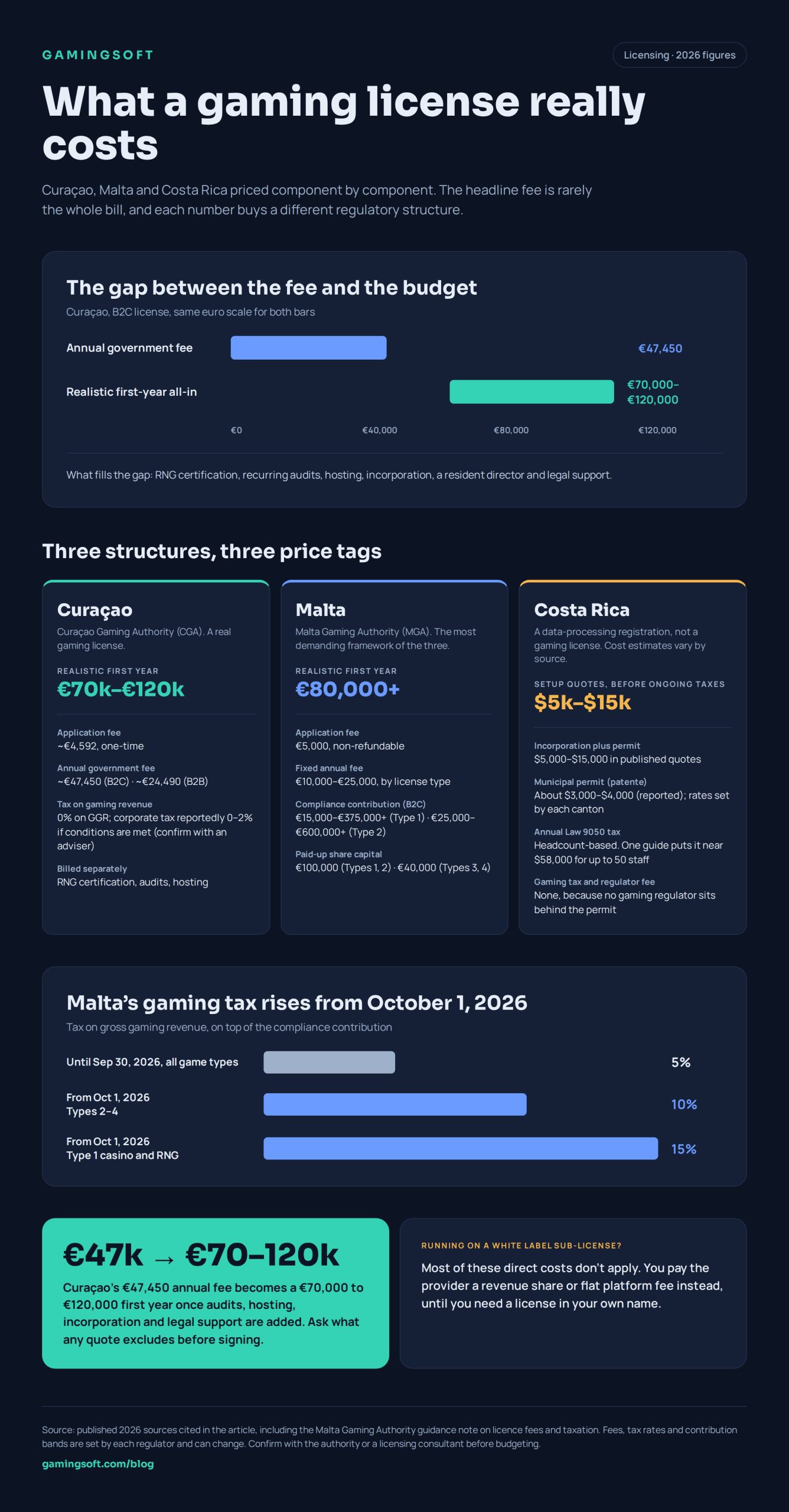
Curaçao’s application fee of about €4,592, plus roughly €47,450 a year in government fees for a B2C license, buys an actual gaming license backed by a dedicated regulator. Malta’s €5,000 application fee, fixed annual license fee, and separate revenue-scaled compliance contribution can push realistic first-year costs past €80,000 and, for larger operators, well into six figures, in exchange for a more demanding regulatory framework and stronger credibility with regulated financial and B2B partners.
None of the three numbers above is “the” cost, in other words. Each one represents the entry cost for a fundamentally different regulatory structure, and the right comparison depends on what an operator is actually trying to achieve. The table below lines the three up side by side before the next three sections unpack where each number actually comes from.
Gaming license cost comparison: Curaçao vs Malta vs Costa Rica
| Curaçao (CGA) | Malta (MGA) | Costa Rica | |
|---|---|---|---|
| Application fee | ~€4,592, one-time | ~€5,000, non-refundable | Not applicable (business registration only) |
| Annual government/license fee | ~€47,450 (B2C); ~€24,490 (B2B) | €10,000–€25,000 fixed fee, depending on license type | No gaming regulator fee; municipal patente and Law 9050 tax apply |
| Revenue-scaled charge | None; 0% on GGR | Compliance contribution: €15,000–€375,000+ (Type 1), €25,000–€600,000+ (Type 2) | None; no gaming compliance contribution |
| Tax on gaming revenue | None on GGR (corporate tax reportedly 0%–2% if conditions are met; confirm with an adviser) | 5% flat until Sept 30, 2026; 15% (Type 1) / 10% (Types 2–4) from Oct 1, 2026 | No gaming tax; headcount-based Law 9050 tax applies |
| Billed separately | RNG certification, audits, hosting | Legal, audit, and consulting support on top of the fees above | Incorporation and resident agent included in the up-front estimate |
| Realistic first-year all-in | ~€70,000–€120,000 | Roughly €80,000 and up | ~$5,000–$15,000 setup, before ongoing taxes |
| Ongoing annual cost after year one | ~€47,450 plus recurring audit and hosting costs | Fixed fee plus compliance contribution and gaming tax, scaling with revenue | Corporate maintenance plus Law 9050 tax and municipal patente |
How to read this table: Curaçao and Costa Rica are largely based on fixed, predictable fees rather than charges that scale directly with gaming revenue. Malta is structured differently: its compliance contribution and, from October 2026, its gaming tax both rise with gross gaming revenue, so the figure shown here is a starting point rather than a ceiling for a growing operator. The next three sections walk through each jurisdiction’s cost component by component.
Curaçao’s Real Cost: Application Fee, Annual Fee, and What’s Extra
Curaçao’s headline numbers are straightforward, and they’re issued by a regulator whose name changed more recently than most guides reflect: the Curaçao Gaming Authority (CGA), which replaced the former Gaming Control Board when the National Ordinance on Games of Chance (LOK) came into force on December 24, 2024.
The application fee is a one-time €4,592. Once licensed, a B2C operator pays roughly €47,450 a year, split between a treasury levy and a CGA supervision fee. B2B license holders, meaning platform and game providers rather than consumer-facing operators, pay a lower annual supervisory fee of about €24,490 instead. Neither figure includes a gaming tax on revenue. Curaçao charges 0% on gross gaming revenue.
Companies that meet the substance and tax-holiday conditions are reported to pay a reduced corporate income tax of roughly 0% to 2% on net profit instead, while one adviser guide cites a 22% statutory profit-tax rate otherwise, so confirm your position with a Curaçao tax adviser. That tax treatment is one of the jurisdiction’s key cost advantages compared with Malta.
What that annual fee doesn’t cover is where operators get surprised, and it’s worth budgeting for these costs before treating the government fee as the whole number. RNG testing and certification are billed separately. Independent compliance and technical audits, covering platform security, RNG integrity, and AML/KYC effectiveness, are recurring costs on top of the government fee. Independent audits of the AML program are mandatory every year.
The size of the audit bill can vary with the scope and complexity of the operation. A large game catalogue, for example, can require more testing and review than a single sportsbook integration. Hosting and technical infrastructure, often expected to meet specific backup and redundancy standards, typically add a few thousand euros a year on their own. 什么是库拉索博彩牌照? covers the application process these fees attach to in more detail.
Add it all up, and a realistic first-year Curaçao cost, including government fees, the audit and infrastructure costs most operators actually incur, plus incorporation, a resident director and legal support, tends, by most consultancy estimates, to land somewhere between about €70,000 and €120,000.
That’s considerably higher than the headline government fee alone suggests. The gap between the headline fee and the fully loaded number is still smaller than Malta’s, as the next section shows, but it’s significant enough to catch out a budget that built around the €47,450 line item alone.
Malta’s Real Cost: Application Fee, Compliance Contribution, and Gaming Tax
Malta’s fee structure has more moving parts than Curaçao’s, and that’s by design, which is one reason its total cost can surprise operators coming from a Curaçao background. The application fee is €5,000 and is non-refundable if the application is rejected.
The fixed annual license fee ranges from roughly €10,000 to €25,000, depending on the license type: €25,000 for Type 1 (casino), Type 2 (sportsbook) or Type 3 (poker and other commission-based games), and €10,000 for operators providing solely Type 4 (controlled skill games).
On top of that fixed fee sits the compliance contribution, and this is the part that actually explains much of Malta’s premium over Curaçao. It’s a separate, revenue-scaled charge that applies only to B2C license holders; B2B operators pay only the fixed annual fee.
For Type 1 gaming services, covering casino and RNG products, the compliance contribution starts at a minimum of €15,000 and can climb as high as €375,000 for high-revenue operators. Type 2 sportsbook licenses start at a minimum of €25,000, with a ceiling as high as €600,000. New operators do get some relief, although the terms differ by category.
An entity approved under the MGA’s start-up directive receives a full 12-month moratorium on the compliance contribution from the date the license is issued. An operator that doesn’t qualify as a start-up can still avoid the full minimum contribution until a full license period has elapsed. In either case, the fixed annual license fee remains payable regardless of start-up status.
Then there’s the gaming tax itself. Until September 30, 2026 it was a flat 5% of gross gaming revenue across all game types. From October 1, 2026 the rate is 15% for Type 1 casino and RNG products and 10% for Types 2 through 4, a change (Legal Notice 84 of 2026) that sits directly on top of whatever compliance contribution an operator is already paying.
Advisers indicate the tax is tied to revenue from Malta-resident players rather than physical presence, so confirm the taxable base with the MGA or an adviser. Add minimum paid-up share capital, which the MGA sets at €100,000 for Type 1 and Type 2 and €40,000 for Type 3 and Type 4, and a realistic all-in first-year cost for a mid-sized operator can pass €80,000 and, by most consultancy estimates, run well into six figures before a single player has deposited.
As revenue grows, so does the ongoing cost, with the compliance contribution and gaming tax scaling alongside it. 在马耳他取得在线博彩牌照 walks through the application steps that these costs are tied to.
Costa Rica’s Real Cost: Why It’s Cheap and What That Cheapness Doesn’t Include
Costa Rica’s price tag looks the simplest of the three, largely because there’s less regulatory machinery behind it to pay for. This is also why it shouldn’t be read as a cheaper version of the same product Curaçao and Malta provide. Published setup quotes for incorporating a local company and obtaining the data-processing permit, the closest equivalent Costa Rica has to a gaming license, generally run from about $5,000 to $15,000 and take a few weeks, with the municipal permit (patente) alone reported at roughly $3,000 to $4,000. The recurring costs are where sources diverge.
Data-processing companies serving betting are reported to pay an annual tax under Law 9050 that scales with headcount, which one 2026 guide converts to roughly $58,000 a year for a team of up to 50 people (we could not verify that conversion independently), and a municipal patente is also due, with rates set by each canton. Because published estimates of the true first-year cost vary widely, confirm the figure with Costa Rican counsel before budgeting.
That’s the entire appeal, and it’s a real one for an operator that needs a corporate structure and a defensible operating base fast. What it doesn’t buy is a gaming regulator standing behind the operation. There’s no gaming compliance contribution because there’s no equivalent gaming compliance regime to fund, and no gaming-specific tax levied through a dedicated online gaming authority, even though the Law 9050 tax and municipal patente still apply.
A bank or payment processor evaluating a Costa Rica-only setup is, in practical terms, evaluating an operator without a dedicated gaming license, backed by a Costa Rican corporate and data-processing structure. Increasingly, that regulatory gap gets priced in accordingly, which is precisely the trade-off the table earlier in this guide was pointing at.
What’s Actually Included in Each License Fee vs What You’ll Pay On Top
Across all three jurisdictions, the pattern is broadly the same even though the numbers differ dramatically: the headline government fee rarely covers all the technical, legal, and compliance work required to stay licensed. Now that each cost structure has been unpacked, it’s worth putting those additional expenses side by side because they’re often where the real budget starts to diverge .
Curaçao’s government fee buys regulatory standing, but not the RNG testing, audits, or hosting and infrastructure work needed to maintain it. Malta’s fixed license fee buys the right to operate, but not the revenue-scaled compliance contribution that supports the MGA’s oversight of a B2C operator, and certainly not the gaming tax due on revenue from October 2026.
Costa Rica’s permit fee buys a registered corporate and data-processing structure, full stop. There’s no comparable gaming audit or compliance layer to pay for because there’s no dedicated gaming regulatory regime behind it, which is precisely why its cost has remained the simplest of the three throughout this guide.
The practical takeaway for a first-year budget is to budget well beyond whatever headline licence fee a jurisdiction advertises, then ask exactly what that figure excludes before signing anything. 2025年开办一家在线赌场需要多少成本? looks at how licensing fits into the broader startup budget alongside platform, payment, and game content costs.
If the case for taking on those licensing costs still needs to be made internally, 为何在线iGaming牌照对您的业务至关重要 covers the business rationale. And if the jurisdiction itself hasn’t been decided yet, 如何选择合适的在线博彩牌照 is the logical place to start.
常见问题
Is Curaçao or Malta cheaper to license?
Curaçao, by a wide margin. A realistic first-year Curaçao cost can land somewhere between about €70,000 and €120,000 once audits, infrastructure, incorporation, and related support are included, while Malta can run past €80,000 and well into six figures once share capital, compliance costs, and other professional expenses are factored in. The difference becomes more pronounced as an operator’s gross gaming revenue grows, since Malta’s compliance contribution and gaming tax scale with revenue while Curaçao’s core government fees remain largely fixed.
Are there ongoing annual costs after the license is issued?
Yes, in Curaçao and Malta. Curaçao charges roughly €47,450 a year for a B2C license, with recurring audit, hosting, and infrastructure costs on top. Malta charges its fixed annual license fee alongside a revenue-scaled compliance contribution and gaming tax for as long as the license remains active. Costa Rica has no gaming regulator fee because there is no dedicated gaming license, but the data-processing permit still carries a headcount-based annual tax under Law 9050 and a municipal patente, so ongoing costs depend heavily on the structure.
Does the license cost cover compliance reporting?
Partially, and this is where operators can get caught out. Malta’s compliance contribution forms part of the cost of maintaining MGA oversight, but it does not replace the operator’s separate reporting, audit, and compliance obligations. Curaçao’s annual government fee covers regulatory supervision, while audits, RNG testing, and other technical compliance work may be charged separately by third-party providers rather than included in the CGA’s fee. Costa Rica has no comparable gaming-specific compliance regime, which is another reason its cost structure is substantially lighter.
What if the operator is running on a platform provider’s sub-license instead of applying directly?
Most of the direct licensing costs above don’t apply in that case. An operator running under a white label provider’s existing Curaçao licensing structure typically pays the provider a revenue share or flat platform fee rather than the government fees described here. These direct-license costs become relevant when an operator outgrows that arrangement, needs a license held in its own name, or requires access to a jurisdiction such as Malta that the provider’s existing license does not cover.
The number that matters isn’t the application fee on a jurisdiction’s website. It’s the fully loaded first-year figure once audits, compliance costs, infrastructure, professional support, and other required expenses are added in: the figure the comparison table above puts side by side. That’s the number worth putting in front of a board before choosing a jurisdiction, not after.
About this guide: Cost figures for Curaçao, Malta, and Costa Rica reflect published 2026 sources as of the time of writing and are cited above. Regulatory fees, compliance contribution bands, and tax rates are set by each jurisdiction’s regulator and are subject to change, so figures here should be confirmed directly with the relevant authority or a licensing consultant before finalizing a budget. Figures were last checked against current sources on October 1, 2026. Where sources disagree, ranges or estimates are shown as such.