An operator putting together a white label casino sets aside roughly $40,000 for “licensing” and figures any of the four names on their shortlist, Curaçao, Malta, Costa Rica, or PAGCOR, will more or less do the same job. Three weeks into due diligence, that assumption falls apart. One jurisdiction turns out not to issue a gambling license at all in the traditional sense.
Another one has just been ruled out entirely by a law most operators outside the Philippines have never heard of. The remaining two solve genuinely different problems, and picking the wrong one means either overpaying for compliance nobody asked for or underpaying for credibility the operator’s payment processor is going to demand anyway.
That $40,000 assumption is the starting point worth correcting, because everything else in this guide follows from it: these four names are not four versions of the same product. This guide compares what each jurisdiction actually costs, how long each one takes, and, more importantly, what each one actually permits. That last part is exactly where the four diverge, and where most licensing consultancy marketing pages tend to stay quiet.
What “Gaming License” Actually Means for a White Label Operation
Before comparing four jurisdictions, it’s worth asking whether an operator needs to pick one at all. Most operators evaluating a white label casino don’t apply for a license directly, and that’s worth making clear upfront. A white label provider typically holds its own master license (usually Curaçao) and issues each operator a sub-license under that umbrella. For many launches, that arrangement is the entire licensing strategy: fast, bundled into the platform fee, and sufficient to open a merchant account with many payment processors.
The comparison in this guide is for the operator who wants something beyond that default. Perhaps the platform provider’s sub-license isn’t accepted by a payment partner the operator wants to work with. Maybe the plan is to target European players directly, where a Curaçao sub-license may not be enough for that audience. Or the operator is simply scaling past the point where borrowing someone else’s license makes sense and wants one of its own. 如何选择合适的在线博彩牌照 walks through that decision point in more detail if it’s not yet clear whether a standalone license is necessary.
Once that decision is made, though, “which jurisdiction” stops being a simple menu. Curaçao, Malta, and Costa Rica genuinely compete for the same use case: an operator wanting to serve international players legally under a licensing structure it controls directly. PAGCOR, as of late 2025, does not. The next few sections explain why that fourth name needs to be handled separately rather than folded into the same comparison.
Curaçao, Malta, and Costa Rica Compared: Cost, Timeline, and Market Access
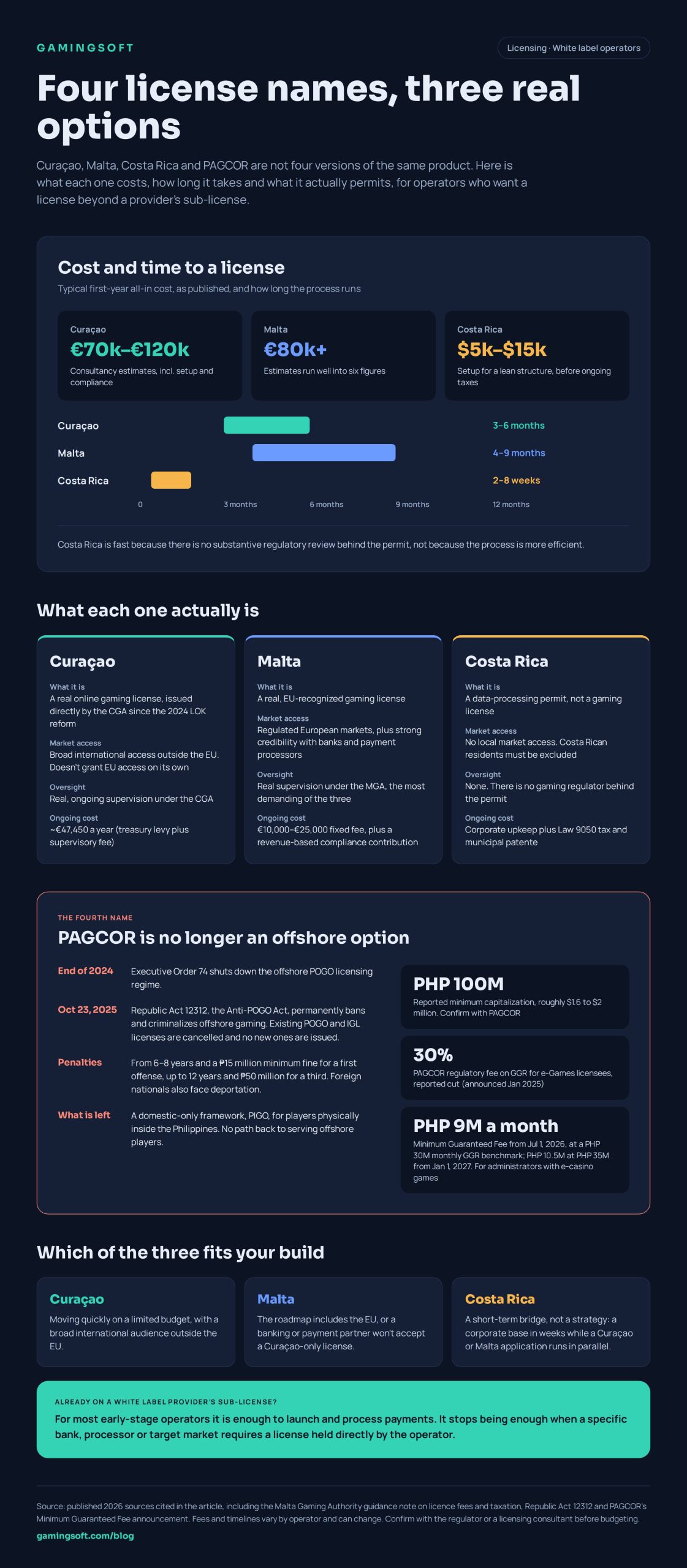
Curaçao is the cheapest and fastest of the three, and it isn’t close—though the regulator behind the licence isn’t the one older guides still name. Since the National Ordinance on Games of Chance (LOK) took effect in December 2024, applicants go directly to the licensing authority rather than through a master license holder. That authority is formally the Curaçao Gaming Authority (CGA), which replaced the former Gaming Control Board (GCB) under the same ordinance.
The application fee runs at about €4,592, on top of roughly €47,450 a year in government fees once licensed, split between a €24,490 national treasury levy and a €22,960 CGA supervisory fee. Published timelines generally put the full process at around three to six months, depending heavily on how complete the paperwork is on first submission. Incomplete applications can add several more months. 什么是库拉索博彩牌照? covers the application process in more detail, including what changed when the old master and sub-license structure was phased out.
Malta sits at the opposite end, and the premium is deliberate rather than incidental. The Malta Gaming Authority (MGA) charges a €5,000 application fee, followed by a fixed annual license fee that depends on the game types covered: €25,000 for a Type 1 (casino), Type 2 (sportsbook) or Type 3 (poker and other commission-based games) authorization, and €10,000 for operators providing solely Type 4 (controlled skill games).
On top of that fixed fee is a separate compliance contribution: a sliding-scale levy on gaming revenue, with its own annual minimums and caps for each license type. In other words, the fixed license fee is a floor, not the whole bill. Minimum paid-up share capital adds another layer: €100,000 for Type 1 and Type 2 and €40,000 for Type 3 and Type 4.
Once application costs, share capital, compliance contributions, audits, and legal support are included, consultancy estimates for realistic all-in first-year costs start around €80,000 and run well into six figures, noticeably more than Curaçao typically requires in the same period. The timeline is longer too, commonly four to nine months depending on how the technical audit progresses.
What that premium buys is EU market access and a reputation that carries real weight with banks, payment processors, and B2B partners who won’t work with an operator relying on a bare sub-license. 在马耳他取得在线博彩牌照 breaks the application process down step by step.
Costa Rica is the outlier of the three, and not in a good way once an operator understands what they’re actually buying. There is no dedicated online gambling license in Costa Rica. Operators register a standard business and obtain what’s effectively a data-processing permit, then run the platform from servers and an office physically located in the country while blocking Costa Rican residents from playing, since serving Costa Rican residents is legally prohibited.
Published setup quotes run from about $5,000 to $15,000 for a lean structure, and company plus permit can be done in roughly two to eight weeks, though bank approval can add months. Recurring costs include a headcount-based annual tax under Law 9050 and a municipal patente, so confirm the real annual figure with Costa Rican counsel.
That speed is the entire appeal. The trade-off is the absence of actual gaming regulatory oversight, which increasingly matters to banks and payment processors when deciding whether to work with an operator at all—a distinction the next section puts side by side with the other two.
Curaçao vs. Malta vs. Costa Rica at a Glance
| Curaçao (CGA) | Malta (MGA) | Costa Rica | |
|---|---|---|---|
| What it actually is | A real online gaming license, direct-issued since the 2024 LOK reform | A real online gaming license, EU-recognized | A data processing permit, not a gaming license |
| Application fee | ~€4,592 | ~€5,000 | Not applicable (business registration only) |
| Ongoing annual cost | ~€47,450 (treasury levy + supervisory fee) | €10,000–€25,000 fixed fee, plus a revenue-based compliance contribution | Corporate upkeep plus Law 9050 tax and municipal patente |
| Typical first-year all-in | Roughly €70,000–€120,000 incl. corporate setup and compliance (consultancy estimates) | Estimates start around €80,000 and run well into six figures, incl. compliance and professional fees | $5,000–$15,000 setup for a lean structure, before ongoing taxes |
| Typical timeline | 3–6 months | 4–9 months | 2–8 weeks for company and permit; banking can add months |
| 市场准入 | Broad international access outside the EU; doesn’t grant EU access on its own | Access to regulated European markets, plus strong credibility with banks and payment processors globally | No local market access; Costa Rican residents must be excluded |
| Regulatory oversight | Real, ongoing supervision under the CGA | Real, ongoing supervision under the MGA, the most demanding of the three | None; there is no gaming regulator behind the permit |
How to read this table: the cost and timeline ranges reflect published 2026 figures and vary by operator complexity, so treat them as planning ranges rather than fixed quotes. Costa Rica’s row looks cheapest by almost every measure precisely because it isn’t answering the same question as the other two; it offers speed and a legal operating base, not gaming regulatory credibility. That distinction is exactly why it is treated differently in the fit-and-restrictions sections below.
That table is useful for a first pass, but the numbers alone can make Costa Rica look like a bargain when it is actually a different product altogether. The next two sections look at which of the three best fits a given build and where each jurisdiction’s restrictions become relevant after launch rather than before it.
Why PAGCOR Isn’t a Real Fourth Option for Most White Label Operators Anymore
Until late 2024, PAGCOR belonged in the comparison above. It doesn’t anymore, and the change is recent enough that plenty of older licensing guides still list it alongside Curaçao and Malta without flagging what happened.
Executive Order 74 shut down the offshore POGO licensing regime by the end of 2024. Then, on October 23, 2025, President Marcos signed Republic Act 12312, the Anti-POGO Act, which permanently banned and criminalized offshore gaming operations in the Philippines.
All existing POGO and IGL licenses were cancelled, no new ones are being issued, and the law also repealed Republic Act 11590, the earlier statute that had taxed and enabled the sector. Operating an offshore gaming business under Philippine jurisdiction now carries penalties that start at six to eight years in prison and a fine of at least ₱15 million for a first offense and rise to as much as twelve years and ₱50 million for a third, with foreign nationals also facing deportation after serving their sentence. That’s a materially different risk profile from a jurisdiction an operator simply chooses not to use, which is the core reason PAGCOR can no longer sit in the same comparison as the three above.
What’s left is a domestic-only framework, sometimes referred to as PIGO, aimed at operators serving players physically inside the Philippines through a land-based-anchored, geo-fenced online product. Licensing guides report a minimum capitalization of around PHP 100 million (roughly $1.6 million to $2 million depending on the exchange rate), but we could not confirm the paid-up requirement with PAGCOR, so verify it directly before budgeting.
Processing and application fees are small by comparison and should be confirmed with PAGCOR. Once licensed, operators pay a PAGCOR regulatory fee on gross gaming revenue, which was reported cut to 30% for e-Games licensees (announced in January 2025; confirm the effective date with PAGCOR). A Minimum Guaranteed Fee structure for PAGCOR-accredited gaming system administrators was deferred more than once and, according to GGRAsia and iGamingToday, took effect on July 1, 2026.
For administrators with e-casino games, the first tranche is PHP 9 million a month once monthly GGR reaches PHP 30 million; a second tranche of PHP 10.5 million against a PHP 35 million benchmark is scheduled from January 1, 2027. The mechanism is designed specifically to prevent operators from underreporting revenue, making PIGO a meaningfully more expensive and closely monitored structure than the domestic framework it replaced.
什么是PAGCOR博彩牌照? covers this domestic structure in more detail, while 如何在菲律宾获得赌场牌照 walks through the application process itself.
None of that resembles what an operator comparing Curaçao, Malta, and Costa Rica is usually trying to solve. Those three jurisdictions exist to license internationally accessible platforms. PAGCOR’s remaining framework, by contrast, is designed for Philippines-only, capital-intensive operation with no path back to serving offshore players. For an operator building a white label casino for a global or regional audience, PAGCOR should therefore be treated as a separate licensing question entirely, not a fourth option on the table above.
Which of the Three Actually Fits Your Build
With PAGCOR set aside, the real decision sits between Curaçao, Malta, and Costa Rica, and none of the three is universally correct. The right pick usually comes down to what the operator’s bank and payment partners will actually accept, not personal preference.
Curaçao fits an operator moving quickly on a limited budget who needs a license active within a few months and plans to serve a broad international market outside the EU. It’s the default for a reason: significantly less expensive than Malta, faster than either alternative, and still credible enough for most crypto and mid-tier payment processors.
Malta fits an operator whose roadmap includes the EU, or one that has already run into a payment processor or banking partner that won’t work with a Curaçao-only license. The cost difference is real, often several times Curaçao’s all-in first-year figure once compliance contributions and share capital are counted, but that premium buys market access and credibility that Curaçao structurally can’t offer.
Costa Rica fits almost nobody as a standalone strategy, honestly, which follows directly from what the table above already showed: it’s cheap and fast because it isn’t a gaming license at all. It can work as a short-term bridge, a way to get a corporate structure and a defensible operating base in place in weeks rather than months while a Curaçao or Malta application moves through its own timeline in parallel. Treating it as a permanent solution tends to catch up with an operator the first time a payment processor asks to see an actual gaming license and there isn’t one to show.
What Each License Actually Restricts
Fit is one question; what happens after the license is active is another. Cost and timeline get most of the attention, but it’s the market restrictions and ongoing compliance burden that can actually burn an operator, not before launch, but months into it.
We could not find a single official Curaçao restricted-country list, but some jurisdictions, such as the Netherlands, are off limits under national law and sanctions lists still apply, so confirm the current position with the CGA or a licensing consultant rather than assuming last year’s guidance still applies. A Curaçao license alone also doesn’t grant EU market access. Operators who need access to regulated European markets have to layer on a separate EU-facing license, usually Malta, rather than relying on Curaçao to cover it. That gap is one of the same factors that pushes EU-bound operators towards the Malta path described above.
Malta’s restrictions run in the other direction, and cost is really the constraint here more than geography. The license itself is broadly permissive within the EU and much of the rest of the world, but the compliance burden, reporting cadence, and gaming tax make the economics more demanding. For Type 1 casino and RNG products, the tax rises from a flat 5% to 15%, while Types 2 through 4 move to 10%, starting October 1, 2026. An operator can go almost anywhere with a Malta license; not every operator can afford to stay there once the ongoing costs, including the higher post-October 2026 tax rate, are fully loaded.
Costa Rica’s restriction is the most literal of the three: the license structure requires blocking Costa Rican residents from the platform entirely because, as already covered, serving Costa Rican residents is legally prohibited. And because there’s no actual gambling regulator behind the permit, “restriction” isn’t really the right word for what operators run into. There’s simply nothing preventing a bank or processor from deciding, on its own assessment, that a Costa Rica-only setup isn’t a real gaming license and declining to work with the operator at all, the same credibility gap the comparison table flagged from the start.
常见问题
Which gaming license is cheapest?
Costa Rica’s setup cost is the lowest on paper, often under $15,000 to get running. Among the two that function as actual gaming licenses, Curaçao is the cheaper one, with an application fee of around €4,592 and roughly €47,450 a year in ongoing government fees. Malta is the most expensive by a wide margin once share capital and compliance contributions are included.
Which gaming license is fastest to obtain?
Costa Rica is typically the fastest, at roughly two to eight weeks for company and permit (bank approval can add months), though that speed reflects the absence of substantive regulatory review rather than a more efficient process. Between the two actual gaming licenses, Curaçao is faster, commonly taking three to six months compared with Malta’s four to nine.
Can I operate in Europe with a Curaçao license?
Not reliably. A Curaçao license doesn’t grant EU market access on its own, and European payment processors and banks may expect an EU-facing licence when working with operators targeting regulated European markets. Operators serious about Europe may therefore need to layer a Malta licence on top rather than relying on Curaçao alone.
Can I still get a PAGCOR license to operate offshore internationally?
No. Republic Act 12312 permanently banned and criminalized offshore gaming licensing in the Philippines as of October 2025, cancelling existing POGO and IGL licenses with no renewal path. The only PAGCOR licensing route left is domestic, geo-fenced to players physically in the Philippines, and it reportedly requires around PHP 100 million in minimum capitalization (confirm with PAGCOR). That makes it a fundamentally different proposition from choosing between Curaçao, Malta, and Costa Rica.
Does a white label provider’s sub-license cover me, or do I need my own?
For most early-stage operators, the platform provider’s sub-license is enough to launch and process payments. It stops being enough when a specific bank, payment processor or target market requires a license held directly by the operator rather than one provided through the platform. At that point, the Curaçao-versus-Malta decision above becomes relevant.
Curaçao, Malta, and Costa Rica are three different answers to the same question. The right one depends on budget, target market, and what an operator’s banking partners will actually accept, and the table earlier in this guide is the fastest way to weigh the three side by side. PAGCOR is no longer part of that question. Get that distinction right before signing anything, because discovering it later, through a rejected payment integration or a license that can’t do what the business plan assumed, can cost far more than any of the application fees above.
About this guide: Cost, fee, and timeline figures for Curaçao, Malta, Costa Rica, and PAGCOR/PIGO reflect published 2026 sources current as of the time of writing and are cited above; regulatory fees, tax rates, and processing times are set by each jurisdiction’s regulator and are subject to change, so figures here should be confirmed directly with the relevant authority or a licensing consultant before budgeting a specific application. Figures were last checked against current sources on October 1, 2026. Where sources disagree, ranges or estimates are shown as such.