
An operator had built a profitable mid-sized casino in Europe. In the third quarter of 2024, they decided to expand into Southeast Asia, targeting Thailand and Vietnam. Their European white label platform was configured and performing well. They launched in the new markets without localizing the payment layer beyond adding a single international card processor.
In Thailand, where the majority of consumer payments flow through TrueMoney and PromptPay bank transfers, their card approval rate was 34%. In Vietnam, where e-wallets like MoMo and ZaloPay account for the bulk of mobile transactions, they had no local payment coverage at all. Their Day-30 conversion rate on first-time visitors was 1.9%. A competitor who had entered the same two markets three months earlier with local payment rails in place was running at 11%.
The product was not the problem. The platform was not the problem. The game library was competitive and the UX was sound. The problem was that a large share of the players they were spending money to acquire were arriving at a checkout flow that could not process their preferred payment method, seeing a generic error or an unsupported option, and leaving without depositing. The acquisition spend was real. The deposits were not.
Market entry in iGaming fails for predictable reasons, and payment localization is the most consistent among them. Operators who treat the payment layer as a later-phase concern rather than a pre-launch requirement pay for it in conversion rates from day one, usually without a clear diagnostic that tells them why the numbers are low.
Why Market Entry Fails: The Payment and Compliance Gaps Operators Miss
The pattern in failed market entries is almost always the same: an operator applies their existing operational setup to a new market, discovers that the setup does not match local conditions, and spends the first several months adapting in response to live failures rather than preventing them during preparation.
Payment incompatibility is the most immediate failure mode because it produces revenue loss from the first session. An operator who has configured their platform for a European market and attempts to apply that configuration to Southeast Asia, Latin America, or Africa encounters a fundamental mismatch: the payment rails that drive conversion in one region are often absent or marginal in another. International card networks that work reliably in Western markets carry approval rates of 30 to 50% in markets where card penetration is low and bank infrastructure is fragmented. E-wallets and local bank transfer methods that have 80-plus percent adoption in those markets are not present in a European-configured platform. The result is a checkout flow that fails for the majority of the target player base without generating an obvious error that would allow the team to diagnose and fix it.
Compliance failures are slower to emerge but more consequential when they do. An operator who launches in a regulated market without the correct license, or who configures KYC and AML workflows that do not meet the jurisdiction’s specific requirements, is not just at risk of regulatory penalties. They are operating with a business model that can be shut down, with player funds at risk and brand reputation damage that affects their ability to enter future markets. The compliance assessment for a new market needs to be completed before the launch decision is made, not after the platform is configured and acquisition campaigns are running.
Product-market fit failures are the third category, and they are the most forgiving in the sense that they can be corrected after launch without the same urgency as payment or compliance failures. A game library that does not include the content categories that drive engagement in the target market, or a bonus structure not calibrated for local player expectations, produces lower retention than an optimized setup but does not cause immediate conversion failure. Understanding what an iGaming platform needs to deliver in a specific market, rather than in general, is the analytical work that separates entries with high conversion from entries that look like acquisition problems but are actually product problems.
Regulatory Assessment: What Operators Need to Know Before Committing
The regulatory landscape in iGaming divides markets into three broad categories: formally regulated markets where a license is required and obtainable, grey markets where gambling activity is not explicitly licensed but is also not actively prosecuted, and restricted markets where gambling is prohibited or where enforcement makes operation impractical. Each category requires a different entry approach.
Formally regulated markets offer legal certainty at a cost. Licensing fees, compliance infrastructure requirements, locally approved game content, responsible gambling tool mandates, and ongoing reporting obligations all need to be factored into the market entry financial model before a commitment is made. Some regulated markets have licensing timelines that run six months or longer, which means the regulatory preparation phase needs to begin well before any platform configuration or marketing investment. An operator who starts the license application after signing a white label agreement has compressed their realistic launch timeline without knowing it.
Grey markets offer faster entry at greater risk. An operator can launch on an offshore license and begin operating in a grey market without the same compliance overhead as a regulated market. The risk is that grey market status can change: regulators in several Southeast Asian and Latin American markets have moved from grey to regulated or from regulated to actively restricted in relatively short timeframes. An operator whose business model depends on grey market access is carrying regulatory risk that does not appear in the financial projections until the moment it materializes.
The local compliance obligations that matter most for operational planning are KYC verification requirements, AML transaction monitoring thresholds, responsible gambling tool mandates, and data residency requirements that affect where player data is stored and processed. These vary substantially across jurisdictions and need to be documented specifically rather than assumed to follow a standard pattern. When evaluating iGaming platform vendors for a new market, confirming that the platform’s compliance infrastructure can be configured to meet the specific jurisdiction’s requirements is a more informative question than confirming whether compliance features exist in general.

Payment Localization: The Conversion Variable Operators Underestimate
Payment localization is the market entry decision with the most direct and immediate impact on conversion, yet it is consistently treated as a technical detail rather than a strategic priority. The operators who get it right before launch convert at multiples of those who retrofit it afterward.
The market-specific payment research that needs to happen before any platform configuration starts covers three questions: which payment methods does the target market’s player base actually use for digital transactions, what approval rates do those methods achieve in practice, and what are the deposit and withdrawal speed expectations that determine whether the payment experience meets or fails player expectations. The answers to these questions differ substantially across markets and cannot be reliably derived from general regional knowledge. A payment method with 60% adoption nationally may have 20% adoption among the specific demographic a sportsbook or casino is targeting.
The payment API integration architecture for a new market needs to cover the primary payment methods for that market, with redundancy routing so that if one gateway underperforms or has an outage, transactions flow to an alternative rather than failing. In markets where bank transfer is the dominant method, the integration needs to handle the specific bank rail infrastructure for that country, which is not interchangeable across countries even within the same region. In markets where e-wallets dominate, each major e-wallet typically requires a separate integration and a commercial agreement that takes time to establish.
Withdrawal configuration is as important as deposit configuration and receives less attention in most market entry plans. The withdrawal expectation in a market is determined by the alternative financial services available: players in markets where same-day bank transfers are standard will not tolerate three-to-five-day withdrawal windows from a casino. Building the withdrawal flow to meet local expectations, and testing it end-to-end before launch rather than discovering the processing time reality from player complaints, is the payment work that determines long-term retention rather than just first-deposit conversion.
Product and Content Localization: Beyond Translation
Language localization is necessary but not sufficient for product-market fit in a new region. An interface translated accurately but without cultural adaptation reads as translated text, and players in markets with strong local digital product ecosystems notice and respond to the difference. Promotional copy that reads naturally in one language often produces awkward or unconvincing results when translated directly. Support documentation that assumes familiarity with Western banking concepts may be confusing for players in markets where those concepts are not common.
Content localization is the dimension that most directly affects early retention. Different markets have game category preferences consistent enough to plan around: live baccarat and live dragon tiger drive engagement in East Asian markets in a way that is disproportionate to their presence in a standard European game library. Football-driven sports betting is the dominant engagement category in many emerging markets, with the specific leagues and competitions that matter varying by country. Slot preferences differ by RTP range, volatility, and theme, with markets in Southeast Asia generally favoring different game aesthetics than markets in Eastern Europe.
The game content decision is also a provider quality question within each category. Two platforms that both offer live baccarat differ in the stream quality, dealer language options, table limits, and mobile performance that determine whether baccarat actually drives engagement in a specific market. An operator who configures live baccarat from a provider whose stream buffers on mid-range mobile devices in the target market has added a category that underperforms because of the execution rather than the preference.
Promotions and bonus structures need to be calibrated to local expectations as well. Welcome bonus terms competitive in a European market may fall below the threshold in a Southeast Asian market where players have been conditioned to expect higher percentage matches or larger free spin allocations. Wagering requirements that are standard in one market may produce higher abandonment rates in another if the playing style preferences mean fewer games contribute fully toward wagering completion.
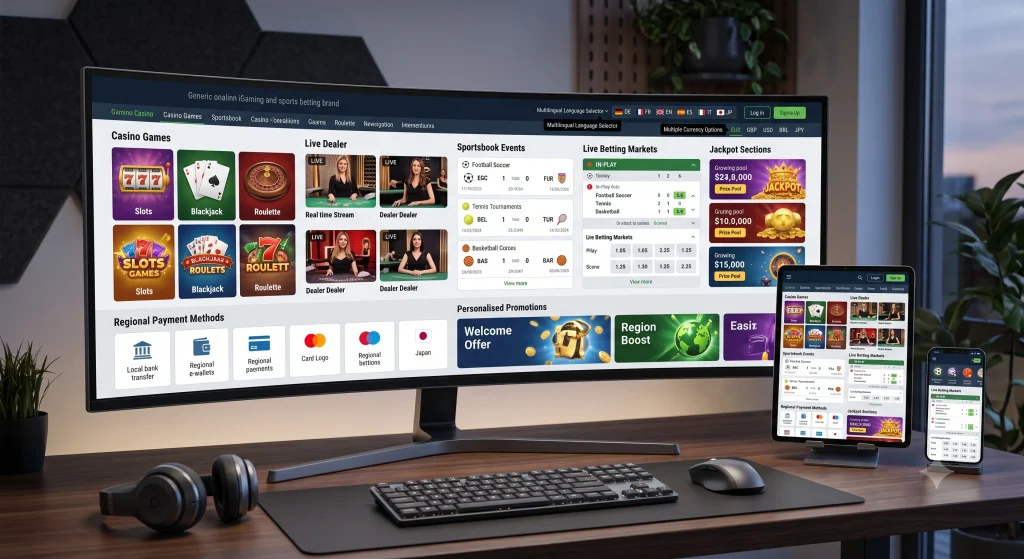
How to Validate a New Market and Build Toward Scale
The most reliable market entry approach treats the first period of operation as a validation phase rather than a full commercial launch. A lean initial configuration, with core payment methods, a curated game library in the categories that drive engagement in the target market, and compliance infrastructure that meets minimum requirements, generates the behavioral data that makes subsequent expansion decisions evidential rather than speculative.
The validation metrics that matter most are concentrated in the payment and retention layers. Payment approval rate by method tells the operator whether the payment configuration is working at the level needed for sustainable conversion. First-deposit rate among registered players reveals whether there is a payment barrier, an offer barrier, or an experience barrier preventing conversion. Seven-day and thirty-day retention rates tell the operator whether the product is creating sufficient reason to return once the welcome period ends.
Data analytics connecting the payment layer, game layer, and player account system in real time produce these metrics at the player segment level, which is where they are most actionable. An aggregate first-deposit rate of 25% is a number. A first-deposit rate of 25% among players who attempted a local bank transfer and 8% among players who attempted an international card is a diagnosis. The difference between these two forms of the same metric is the difference between knowing something is wrong and knowing what to fix.
Market entry model selection also affects how quickly validation can happen. A white label entry versus a custom build represents a significant difference in time-to-first-data. An operator on a white label platform can generate real market data in weeks and make informed expansion decisions within a quarter. An operator on a custom build is making market assumptions for twelve to eighteen months before they have the data to confirm or refute them. For new market entries where the operator does not have established player relationships, the white label approach’s speed advantage compounds into a data advantage that influences every subsequent investment decision.
Frequently Asked Questions
What is the single most important factor in a successful iGaming market entry?
Payment localization. An operator who enters a new market with the correct local payment methods configured and performing at high approval rates will generate first-deposit conversion from day one. An operator who enters with an incompatible payment layer spends their acquisition budget reaching players who cannot complete a deposit. No game library, no welcome bonus, and no UX improvement compensates for a checkout flow that fails the majority of the target player base. Regulatory compliance is equally critical for long-term viability, but payment performance is the variable that determines whether revenue is generated in the first week.
How should operators assess whether a market is worth entering?
Market size, regulatory status, competitive density, and payment infrastructure accessibility are the primary filters. A large market with a clear regulatory path, underserved player demand, and accessible local payment rail integrations is a strong candidate. A large market with a formal license requirement that takes nine months to obtain, two dominant incumbent operators, and payment infrastructure that requires establishing individual commercial relationships with each local provider is a different calculation. Regulatory timeline and payment readiness are the constraints that most affect whether the financial model for a new market is realistic in the timeframe the operator is working within.
How long does entering a new iGaming market typically take?
On a white label platform with pre-existing payment integrations in the target market, three to eight weeks from contract signing to a functional soft launch is achievable when operator-side preparation is complete. On a custom build, twelve to eighteen months is typical. Regulatory preparation can extend the timeline further: markets with formal licensing requirements that take six months or longer to obtain require that the license application starts before any platform configuration begins. Operators who have previously entered similar markets can compress the preparation timeline; those entering a new type of regulatory environment typically require more time for the compliance work.
What makes localization more than just language translation?
Language translation changes the words. Localization changes the experience. A properly localized product has promotional copy written for the target market’s cultural context rather than translated from another market. It has game content selected for the categories and specific titles that drive engagement in that player population. It has payment methods that match how players in that market conduct digital financial transactions. It has customer support staffed with agents who understand the market’s expectations around response time and communication style. An operator can complete a translation pass in a week. Genuine localization is a multi-month preparation effort that, when done well, produces meaningfully better retention from the first acquisition campaigns.
What role do local partnerships play in market entry?
Local partnerships with affiliates, established operators, or regional payment processors reduce the market knowledge gap that makes new entries expensive. A regional affiliate who has been generating traffic in the target market for several years understands the player acquisition channels, the competitive landscape, and the seasonal patterns that a new entrant would need months of live operation to learn. A local payment processor relationship can accelerate approval rate performance without the months of relationship-building that new integrations typically require. Partnerships are particularly valuable in markets where local business relationships and regulatory goodwill matter, such as emerging regulated markets where demonstrating local commitment can influence the licensing process.
How should operators decide between white label and custom platform for a new market?
For a first entry into a market where the operator does not have established player relationships or proven conversion data, white label is almost always the better choice. The time-to-data advantage is significant: white label generates real market behavioral data in weeks, while a custom build generates that data in twelve to eighteen months. The market assumptions that drove the entry decision can be validated and corrected much earlier on white label. For a second entry in a market where the operator has proven demand, understands the player base, and has specific product requirements that no existing platform can satisfy, a custom build may become the right answer. The decision should be driven by how much the operator already knows about the market, not by how much operational control they ultimately want.
Entering a new iGaming market is a commitment that requires specific preparation rather than a scaled copy of an existing operation. The operators who generate revenue from day one in a new market are those who solved the payment localization, regulatory compliance, and product fit questions before the acquisition budget started running. Those who treat these as post-launch optimizations spend the first quarter discovering in live data what their preparation should have revealed before the first campaign fired.
Industry events are where ideas turn into partnerships, and Gamingsoft is a consistent presence at the most important conferences on the global iGaming calendar. We attend these gatherings to stay close to the operators, developers, and regulators shaping the industry. Many of our strongest partnerships began with a conversation at an event. Our team is always ready to discuss game aggregation deals, market challenges, or anything else on your mind. Visit gamingsoft.com and connect with our business development team today.