
An operator running a mid-sized online casino launched an aggressive welcome bonus campaign in Q3. The offer was competitive, the marketing drove strong acquisition numbers, and players started claiming in volume.
Three weeks in, the finance team noticed something wrong. Players who had been wagering on blackjack and roulette were clearing their wagering requirements far faster than the numbers should have allowed. The bonus system was calculating contributions at 100% across all game types.
The actual contribution rules were 10% for table games and 5% for live casino. Nobody had configured the game-specific wagering weights correctly, and the campaign engine was not cross-checking against the game provider’s contribution data. By the time the error was caught, six figures in bonus funds had been released to players who had not met the actual conditions. Manual reversals, account suspensions, and a week-long bonus freeze followed.
The failure was not a bonus design problem. The offer itself was fine. The problem was that the campaign engine was not properly synchronized with the game provider layer beneath it, and the wagering calculation logic had never been tested against real provider contribution data before the campaign went live.
This kind of failure is more common than operators like to admit. A casino bonus engine touches more parts of the platform than almost any other system: the wallet, the game aggregator, the CRM, the fraud stack, and the analytics layer. When those connections are loose or untested, the promotional infrastructure becomes a source of financial leakage rather than a retention tool.
What a Casino Bonus Engine Actually Does
At its most basic, a bonus engine detects player actions, evaluates whether those actions meet predefined conditions, calculates the appropriate reward, and credits it to the player’s account. Deposit completed, bonus triggered. Wager threshold reached, free spins released. Session milestone hit, cashback applied. The sequence sounds straightforward. The implementation is considerably more complex.
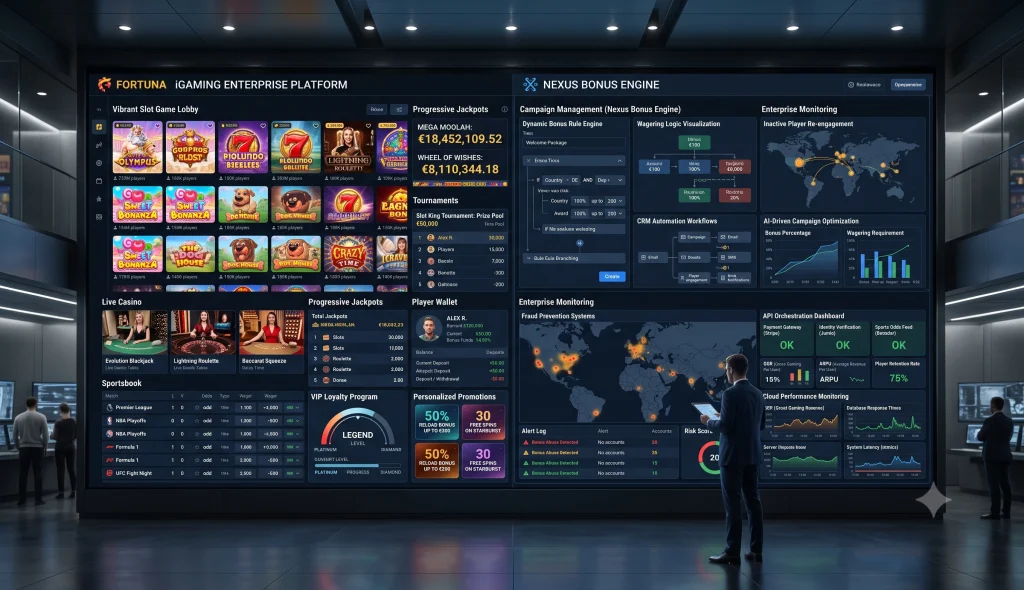
The engine itself typically sits between several other systems. On one side, player events flow in from the game platform, the payment layer, and the session manager. On the other side, bonuses are credited to the wallet and wagering progress is tracked against conditions set in the campaign configuration. In between, a rules engine evaluates eligibility, applies the correct logic for each bonus type, and handles the edge cases that inevitably arise: what happens when a player disconnects mid-session, or deposits twice before the first bonus is credited, or tries to withdraw while wagering requirements are partially met.
The modular view of a bonus system breaks into a few distinct layers. The event layer captures what the player just did. The rules engine decides whether that action triggers anything and what the result should be. The calculation layer works out the actual reward value, including any multipliers, contribution weights, or expiry conditions. Then the wallet integration credits the funds and locks or unlocks balances based on wagering state. Above all of this sits the campaign management layer, where operators configure promotions, segment players, and set the parameters that flow down through the rest of the stack.
Each layer can work well in isolation. The challenge is making them work together at speed, under volume, with consistent results across multiple game providers who each handle contribution data differently. This is one of the reasons why building infrastructure that scales with your player base should account for the bonus engine as a first-class concern, not an afterthought.
The Synchronization Problem Most Operators Underestimate
The scenario in the opening is not unusual because operators are careless. It is common because the synchronization problem between a bonus engine and a game provider layer is genuinely difficult, and it only becomes visible under production conditions.
Different game providers report wagering data on different schedules and in different formats. Some push round results in real time. Others batch them every few seconds. A handful deliver end-of-session summaries. When the bonus engine expects real-time data and receives batched data instead, wagering calculations drift. A player’s displayed progress lags behind their actual wagering. In some edge cases, conditions appear to be met before they actually are, and bonuses are released early.
Game contribution rules add another dimension. A standard slot might contribute 100% to wagering requirements. Blackjack might be 10%. Live casino baccarat might be 5%, or excluded entirely depending on the operator’s configuration. These weights are set per provider, per game category, and sometimes per individual title. If the bonus engine applies a single global contribution rate rather than pulling provider-specific weights, every wagering calculation for table game players is wrong. The error is silent. No exception is thrown. The player just clears their requirements faster than intended.
Wallet synchronization is the third failure point. Bonus balances, real-money balances, and pending withdrawal amounts need to be consistent across the wallet and the bonus engine at all times. When a player deposits, the bonus credit must hit before the next game round starts, not after. When wagering requirements are met, the balance unlock needs to reach the wallet in time for the player to withdraw without hitting a delay that generates a support ticket. These are real-time consistency requirements, and they are harder to meet than they look. The payment API integration layer is often where this consistency breaks down, particularly when multiple payment methods hit the wallet through different processing paths.
How the Rules Engine and Event Layer Work Together
The rules engine is the core of any promotional system. It is where eligibility conditions are defined, wagering logic is encoded, and the sequence of bonus events is controlled. Getting it right determines whether operators can run complex campaigns independently or need engineering involvement for every change.
Modern bonus engines are event-driven rather than batch-processed. Player actions, deposit confirmed, game round completed, loss threshold crossed, generate events that are pushed to the engine in real time. The rules engine subscribes to the event types it cares about and evaluates each one against active campaign conditions. If a player’s deposit of $100 matches an active “first deposit 100% match” campaign, the engine calculates the bonus amount and triggers the wallet credit immediately. No polling, no scheduled jobs, no ten-minute delay between the deposit and the bonus appearing in the player’s account.
Stateless rule execution is an important architectural property here. Rules should be evaluated without depending on the system’s current state beyond the event data and the player’s campaign record. This makes the engine horizontally scalable: multiple instances can process events in parallel without conflicts. It also makes rules easier to test in isolation, which matters when you are trying to verify that a new campaign configuration will behave correctly before it goes live to players.
Campaign configuration is where operators spend most of their time, and it is worth building well. A system that requires a developer to modify code in order to change wagering requirements or add a new eligible game category will create a bottleneck in marketing operations. No-code campaign builders, where operators configure bonus logic through an interface rather than through tickets to the engineering team, have become standard in competitive platforms. They reduce launch time for new campaigns and lower the cost of iterating on promotional mechanics based on what the data shows. The way casino data analytics informs campaign performance is only useful if operators can act on it quickly, and a slow deployment cycle for bonus changes undermines that entirely.
Fraud Detection and Bonus Abuse Prevention
Bonus abuse is not a fringe problem. It is a structural risk that grows with acquisition volume and gets more expensive the longer it goes undetected.
The most common forms are multi-accounting, where players create multiple accounts to claim welcome bonuses repeatedly, and advantage play, where a player identifies bonus terms that can be gamed through low-variance wagering strategies. Both are detectable. Multi-accounting leaves fingerprints across device identifiers, IP addresses, payment methods, and behavioral patterns. Advantage play shows up in the wagering data as concentrated bet sizing on specific game types at specific stake levels. Neither pattern looks exactly like fraud to a rule-based system checking only a single signal. Caught together, they are much easier to flag.
Fraud detection should be integrated into the bonus engine rather than layered on top as a separate audit function. By the time a manual review team spots a pattern, a successful advantage player may have already cleared requirements and withdrawn. Real-time signals need to trigger real-time responses: flag the account for review, pause the bonus, and hold the withdrawal pending verification. An automated hold that lasts twelve hours costs far less than a completed withdrawal of improperly earned funds.
The rules engine can enforce basic structural protections without fraud detection tooling: minimum odds requirements for sports betting bonuses, maximum bet sizes while wagering is active, and game restrictions that exclude low-variance titles from contribution. These do not stop determined abuse, yet they significantly raise the cost of advantage play for casual exploiters. Combined with behavioral monitoring tied to the platform’s analytics layer, they form a layered defense that most operators find sufficient for the majority of abuse cases.
Campaign Management and CRM Integration
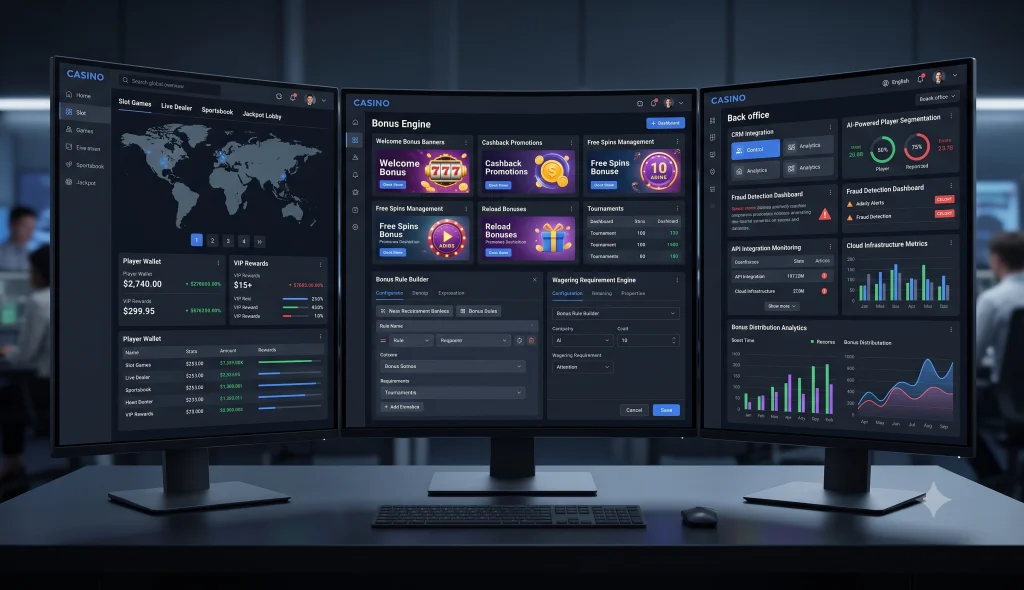
A bonus engine that cannot talk to the CRM is a broadcast system. It can offer the same promotion to every player. What it cannot do is offer the right promotion to the right player at the right moment, which is where retention value actually comes from.
CRM integration gives the campaign engine access to player segmentation data. A player who deposited twice in their first week and has not returned in thirty days is a different candidate than one who deposits weekly but has never used a free spin offer. Different triggers, different bonus types, different timing. Personalized campaigns consistently outperform generic ones on both redemption rates and the net revenue generated per bonus dollar spent. The iGaming platform needs to support this kind of bidirectional data flow between the CRM and the campaign engine rather than treating them as separate systems.
A/B testing capability is worth building into the campaign layer from the start, not adding later. Running two versions of the same bonus with different wagering requirements across matched player segments produces data that cannot be obtained any other way. The findings compound over time into a set of calibrated campaign parameters that reduce bonus cost per active player without reducing retention effectiveness. Operators who run their promotional strategy on intuition and competitor observation tend to overspend on bonuses relative to what the data would justify.
Audit logging deserves attention as well. Every bonus event, from trigger to credit to wagering update to withdrawal unlock, should be recorded with enough detail to reconstruct the full sequence for any player at any point. Regulatory requirements in most markets mandate this. Beyond compliance, it is the primary tool for investigating player disputes and identifying where the system behaved unexpectedly. An engine that cannot produce a complete audit trail for a single player’s bonus history is an operational liability, particularly as volume grows and individual player interactions become harder to trace manually. When evaluating igaming platform vendors, the quality of bonus audit logging is one of the more telling questions to ask.
Frequently Asked Questions
What is a casino bonus engine?
A casino bonus engine is the backend system that manages how promotional rewards are triggered, calculated, and distributed to players. It connects player actions from the game platform and payment layer to eligibility rules, wagering logic, and wallet credits. Bonuses are evaluated and credited based on conditions configured by the operator rather than manually processed. The engine handles the full lifecycle from trigger to wagering completion to balance unlock.
Why is synchronization between the bonus engine and game providers so critical?
Different game providers deliver wagering data on different schedules and in different formats, and each applies its own contribution rates by game category. If the bonus engine uses a single global wagering rate rather than provider-specific weights, every table game and live casino calculation will be wrong. The error is silent, no exception is thrown, yet players clear requirements faster than intended. The financial cost of this kind of misconfiguration is typically discovered weeks after launch, by which point significant bonus funds have already been incorrectly released.
What does event-driven architecture mean for a bonus engine?
Rather than running scheduled jobs that check for bonus eligibility at fixed intervals, an event-driven bonus engine responds to player actions in real time. A deposit event, a completed game round, or a loss threshold being crossed each trigger an immediate evaluation against active campaign rules. The result is faster bonus crediting, more accurate wagering tracking, and the ability to run time-sensitive promotions such as live tournament rewards without introducing processing delays.
How does a bonus engine prevent abuse and advantage play?
Structural protections in the rules engine handle the baseline: game restrictions, minimum bet requirements, maximum stake limits while wagering is active. Behavioral detection handles the rest, flagging patterns like concentrated low-variance wagering, multi-account indicators across device and payment fingerprints, and unusually fast requirement completion on high-margin games. These signals are most effective when connected to an automated hold mechanism that pauses withdrawals for review rather than blocking them outright. A twelve-hour review hold is far cheaper than a completed withdrawal of incorrectly earned funds.
What should operators look for when evaluating bonus engine platforms?
Provider-specific wagering contribution support is non-negotiable: a platform that applies global contribution rates will miscalculate for any player using table games or live casino. Real-time wallet synchronization matters for player experience and for dispute resolution. No-code campaign configuration reduces marketing’s dependency on engineering. Fraud detection that is integrated rather than bolted on responds faster. And full audit logging, at the individual event level for every player, is both a regulatory requirement and the primary tool for investigating anything that goes wrong after launch.
Building a casino bonus engine well is mostly about getting the integrations right. The promotional logic itself is rarely the hard part. Synchronization with game providers, real-time wallet consistency, CRM-connected personalization, and layered fraud detection are where the complexity lives, and where the financial consequences of getting it wrong show up most clearly. Operators who treat the bonus engine as core platform infrastructure rather than a feature layer tend to run more profitable campaigns with fewer operational incidents.
Gamingsoft regularly expands its network of game studio partnerships, so operators on our platform always benefit from fresh, high-quality content without any additional integration work on their end. Each new provider we onboard goes through careful quality and compliance review. If you want to be among the first to offer the latest game releases alongside proven blockbusters from established developers, Gamingsoft is the aggregation partner you need. Contact us to get started and see what is possible for your platform.