
A sportsbook operator in Eastern Europe launched their platform on a Thursday. By Saturday afternoon, during the opening weekend of the Champions League group stage, their odds feed provider went down. Markets suspended. Players could not place bets. The operator had no backup provider, no failover system, and no normalization layer that would have made switching sources even remotely fast. They lost an estimated 40% of that weekend’s handle. The feed came back up on Sunday morning.
That story is not unusual. It is, in fact, one of the more predictable failures in sportsbook operations. The odds feed is not a background utility. It is the product. Every market displayed, every price shown, every bet accepted flows through it. Operators who treat the feed as a vendor checkbox rather than a core infrastructure decision tend to find out the hard way what that distinction costs.
Building a reliable odds feed means understanding what data you need, where it comes from, how to normalize it, how pricing logic sits on top of it, and how the whole stack connects to your risk engine and frontend. None of those layers are complicated in isolation. The challenge is that they all have to work together, at speed, without gaps.
What an Odds Feed Actually Consists Of
The phrase “odds feed” sounds simple enough. One data pipe, one set of numbers. The reality is a stack of distinct data streams that have to be synchronized and processed before anything reaches a player.
At the foundation is event data: schedules, team lineups, match status, and real-time score updates. On top of that sits market data, the actual betting options available for each event, from match winner to first goalscorer to in-play total corners. Pricing data layers on next, and this is where the numbers players see come from. Then settlement data closes the loop, delivering results and enabling correct market grading after events finish.
Each of these streams has different latency requirements. Pre-match event data can be fetched hours in advance. Live pricing during a football match may need to update every few hundred milliseconds, especially around goals, red cards, or injury stoppages when the risk profile of a market changes instantly. Settlement data matters less for speed and more for accuracy. Getting the result wrong grades bets incorrectly, which creates disputes and eats into operational time.
The feed also connects to two distinct downstream systems: the sportsbook frontend, which shows markets to players, and the risk engine, which monitors exposure and decides when to adjust prices or suspend markets. Operators who have gone through the white-label casino onboarding checklist will recognize this as one of the integration points most commonly underspecified at launch. Both systems need the same underlying data, but they have different processing needs. A frontend needs clean, display-ready prices in the right format. A risk system needs raw exposure numbers and betting volume data to make decisions. Understanding that distinction shapes how you architect the normalization and distribution layers.
Where Sportsbook Operators Source Their Odds
There are three broad approaches, and which one fits your operation depends on your stage, your margin targets, and how much trading expertise you have in-house.
Managed odds providers are the most common starting point for new operators. These suppliers deliver pre-priced markets with built-in margin, along with trading services that handle liability management on your behalf. You get faster time-to-market, lower operational complexity, and no need to build internal trading teams. The trade-off is margin share. Because the provider is absorbing risk and doing the pricing work, their cut comes off your top line. For operators launching a white-label sportsbook or entering a new market, that trade-off typically makes sense early on.
Raw sports data providers take a different approach. They deliver event data, scores, and statistics without pre-built pricing. Operators who go this route build their own odds internally, which gives them greater control over margin and the ability to offer more competitive prices on markets they know well. It also requires a trading operation, proprietary pricing models, and significantly more infrastructure. Most operators who go this route have either migrated from managed feeds after reaching sufficient scale, or they specialize in a narrow set of sports where they have genuine expertise.
A hybrid model sits between the two. Many mid-tier operators use managed odds for the majority of their markets while building internal trading capacity for the sports or leagues where their player base concentrates most of its volume. Over time, they shift more markets in-house as their risk tolerance and technical capability grow. This is worth considering when you look at how to evaluate igaming platform vendors, since the platform’s architecture will determine how easily you can add or swap feed providers as your strategy evolves.
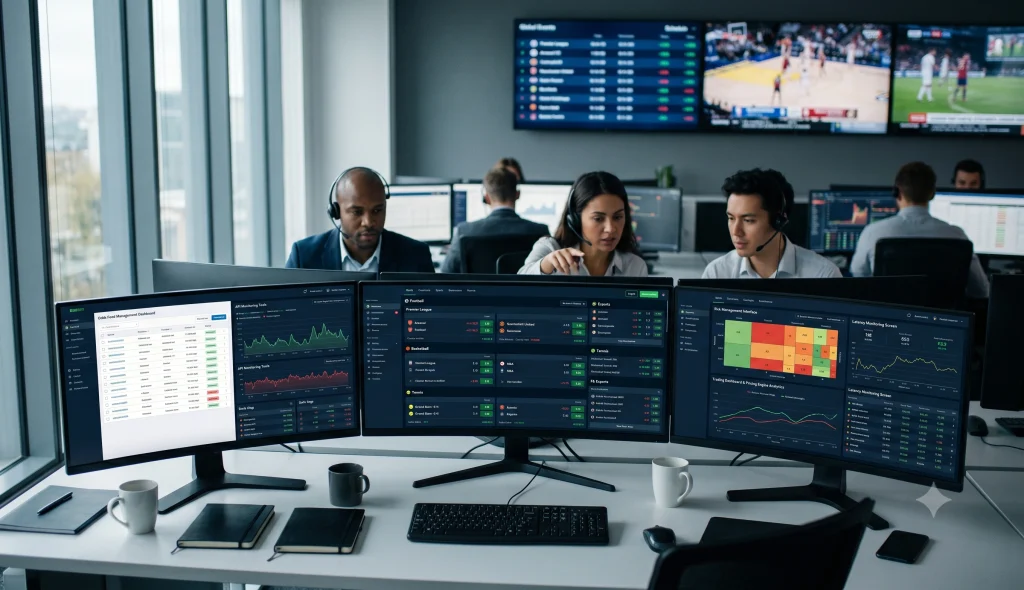
The Normalization Problem Most Operators Underestimate
Every odds provider delivers data in their own format. Team identifiers, market names, odds representations, event structures: none of it is standardized across the industry. One provider might identify a football match by a numeric event ID. Another uses a string. One delivers decimal odds, another fractional. One calls the market “Match Result,” another calls it “1X2.” Even league names vary, with providers using different spellings, abbreviations, and regional conventions for the same competition.
When an operator integrates a single provider without a normalization layer, this is invisible. The problem surfaces the moment they add a second provider, try to compare prices across sources, or need to switch providers quickly. At that point, every inconsistency in the data structure becomes a manual mapping problem, and those problems compound at speed.
A normalization layer sits between incoming provider data and the rest of the stack. Its job is to translate everything into a single internal schema, whatever naming conventions and identifiers your platform uses. When a new provider comes in, the mapping work happens once at the normalization layer. The downstream systems, risk engine, frontend, settlement processor, see nothing change. This is the architecture decision that makes multi-provider support practical rather than theoretical, and it is also what lets you run redundant feeds without the failover becoming an operational crisis.
Normalization also handles odds format conversion. Players in different markets expect different formats: decimal in Europe, fractional in the UK, American moneyline in North America. The conversion logic should live in the normalization layer so that pricing accuracy is maintained regardless of what format the downstream frontend requests. This connects directly to the broader infrastructure question of how to build infrastructure that grows with your player base, since a normalization layer designed for one provider will not scale cleanly to five.
How Pricing Logic Shapes Your Margin
Raw odds from a managed provider already include a margin. But understanding how that margin is structured matters for operators who want to control profitability rather than simply accept whatever the feed delivers.
The core concept is overround. On a two-outcome market like a tennis match, true probability on each side might be 50%. A sportsbook might price both outcomes at 1.91 in decimal, which implies 52.4% probability on each side. The total implied probability is 104.8%, meaning the book holds roughly 4.8% over time. That overround is how sportsbooks generate consistent profit from pricing rather than from predicting outcomes better than bettors.
Managed odds providers build their own overround into prices before delivery. Operators can then apply additional margin on top, or adjust specific markets to reflect local competitive dynamics. Running a sportsbook in a market where players are particularly sharp on domestic football, for instance, might mean tightening that margin to stay competitive while widening it on markets where the playerbase is more recreational.
Beyond margin, pricing logic also handles market adjustments in response to betting volume. When a significant amount of money comes in on one side of a market, the risk engine triggers a repricing to bring the book back into balance. Whether that repricing is automatic or manual depends on your trading setup, but the mechanism must be built into the architecture from the start. This is one of the areas where the how to QA test a casino API before going live checklist principles transfer directly to sportsbook contexts: you need to stress-test pricing behavior under volume before it happens in production.
Live Betting Feed Requirements
Pre-match odds are forgiving. Markets open hours before kickoff, prices move gradually, and there is time to catch and correct errors. Live betting removes all of that margin. During an in-play event, odds can shift significantly in seconds, and the tolerance for stale or incorrect prices is essentially zero.
The latency requirement for live feeds is measured in hundreds of milliseconds, not seconds. When a goal is scored, markets need to suspend immediately, before sharp bettors with faster data can exploit the delay. When a player is sent off, win probabilities shift dramatically and prices need to reflect that before the market reopens. The faster the feed, the less exposure the book carries during those critical windows.
Suspension controls are equally important. Markets should suspend automatically when certain event triggers occur: goals, red cards, injuries, VAR reviews, and match interruptions are the obvious ones. The suspension rules need to be configurable and they need to be tested thoroughly in pre-launch QA, not discovered during a live Premier League match. Operators who build their live betting infrastructure without explicit suspension logic tend to find that the risk exposure during those uncovered windows is significant.
Failover is the third leg. Live betting with a single data provider is an operational liability. When the feed drops during a high-volume event, the options without a backup are limited: suspend all live markets and lose the handle, or keep markets open with stale prices and absorb the losses. Neither is acceptable at scale. A secondary provider that can take over automatically, even with slightly less market depth, is a non-negotiable part of a production live betting architecture.

Risk Integration and What Operators Overlook
An odds feed that is not connected to a risk engine is essentially a display system. It shows prices and accepts bets, but it cannot respond to what those bets reveal about the book’s exposure. Risk integration is what turns a pricing system into a profitable sportsbook operation.
The risk engine monitors incoming bet volume by market, by event, and by bettor profile. When exposure on one side of a market exceeds a threshold, it can trigger automatic repricing to attract volume on the other side, reduce bet limits for certain player segments, or suspend the market entirely. Sharp betting activity from a specific account or IP range might trigger manual review or automatic restriction. These are not edge cases. For any sportsbook with meaningful volume, these events happen constantly during major sporting events.
The connection between the odds feed and the risk system needs to be bidirectional. The feed sends market data and pricing in one direction. The risk system sends limit adjustments and suspension signals back. The latency on that loop matters during live betting, where decisions need to happen in near real-time. Operators building this connection for the first time often underestimate how much of the risk system configuration happens at the market level rather than the account level. Per-event, per-market exposure limits need to be set and monitored separately from account-level restrictions.
Understanding what is an igaming platform encompasses this risk layer too. Platforms that handle casino operations natively may not have the sports-specific risk tooling operators need, which is one of the more important questions to ask when evaluating vendors. The feed integration and the risk architecture have to match the platform’s capabilities, or the gaps become manual operational problems.
Frequently Asked Questions
What is a sports betting odds feed?
A sports betting odds feed is a data system that delivers betting markets, pricing, live scores, and settlement information from one or more data providers to a sportsbook platform. It acts as the connection between external sports data suppliers and the internal systems that display odds to players, manage risk, and settle bets. Without a functioning feed, a sportsbook cannot open markets or accept wagers.
Where do sportsbooks get their odds from?
Most sportsbooks source odds from managed trading providers who supply pre-priced markets with built-in margin and risk services. Larger operators may build proprietary pricing on top of raw sports data, which gives them more margin control but requires significant trading expertise and infrastructure. Many operators use a hybrid approach, relying on managed feeds for most markets while developing internal trading capacity for the sports or leagues where their volume concentrates.
Why does data normalization matter for an odds feed?
Different odds providers use different data formats, identifiers, and naming conventions. Without a normalization layer that standardizes this data before it reaches the rest of the platform, adding or switching providers becomes a significant manual mapping exercise. A normalization layer makes multi-provider support practical, simplifies failover during outages, and ensures consistent display across all player-facing surfaces regardless of which provider the data came from.
What makes live betting feeds more complex than pre-match feeds?
Live feeds require much lower latency, typically in the hundreds of milliseconds range, because odds shift rapidly during events and even brief delays expose the book to sharp bettors with faster data access. Live feeds also need automatic suspension controls that trigger on specific in-game events such as goals, red cards, or VAR reviews. Add to this the need for redundant provider failover, and the infrastructure requirements for live betting are substantially heavier than for pre-match markets.
Should operators use more than one odds provider?
Yes. Single-provider dependency creates an operational risk that becomes most visible during high-volume events when outages are most costly. A secondary provider, even with less market depth, allows automatic failover that keeps markets open during provider issues. Multi-provider setups also enable price comparison and market selection, which can improve the competitiveness of the product over time.
How does the odds feed connect to risk management?
The odds feed and the risk engine operate as a bidirectional loop. The feed delivers market data and pricing; the risk engine monitors betting volume and exposure and sends back limit adjustments and suspension signals. During live betting, this loop needs to close in near real-time. Operators who treat the feed and the risk system as separate concerns rather than a connected architecture tend to find exposure gaps during high-volume events when both systems are under the most pressure.
Building a sports betting odds feed is less about the data itself and more about what surrounds it. The normalization layer, the risk integration, the failover architecture, and the pricing logic are what separate a sportsbook that performs under pressure from one that goes dark on a Saturday afternoon. Operators who invest in that infrastructure early, before scale forces the issue, end up with far more flexibility in how they grow.
Gamingsoft is a leading iGaming aggregator connecting casino operators with over 200 top-tier game studios through a single API integration. Our GS Connect platform provides instant access to more than 10,000 games across slots, live casino, sports betting, and fishing games — without requiring separate negotiations with each provider. We support multiple currencies and languages, making it simple to enter new markets quickly. Our technical team is available around the clock to ensure seamless platform performance. Whether you are launching a new platform or expanding an existing game library, Gamingsoft has the tools and partnerships to accelerate your growth. Get in touch to learn what we can do for your business.