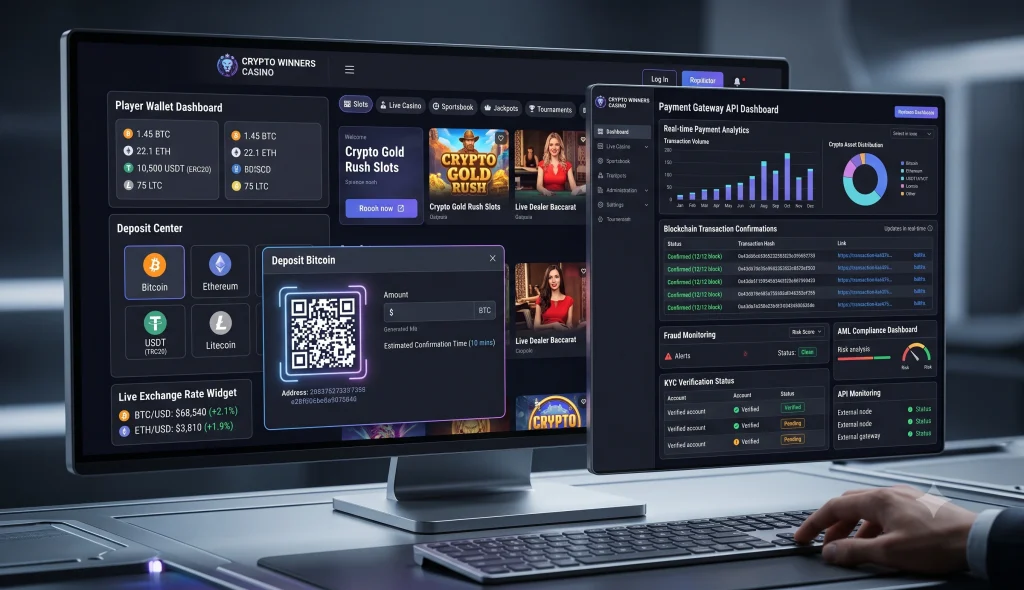
An operator enabled Bitcoin deposits two weeks before launch. The payment gateway was configured, test transactions had cleared without issues, and the integration looked clean. Three days after going live, a player made a $400 deposit during a period of unusually high network activity on the Bitcoin blockchain. Confirmation came through after 94 minutes.
The gateway registered it. The webhook that was supposed to notify the casino platform and update the player’s balance did not fire correctly. The player contacted support. The support team had no visibility into pending blockchain transactions and could not explain why the balance had not appeared. After two hours on chat and three follow-up messages, the player requested a reversal and did not return.
The crypto integration itself had worked. The Bitcoin was received and confirmed on-chain. What failed was the connection between the payment gateway and the platform. No fallback mechanism existed for webhook failures. No monitoring was in place to flag delayed confirmation updates. No tool was available to support staff to look up a blockchain transaction and match it to a player account.
This is the failure mode that most crypto integration guides do not cover. Enabling a payment method is the simple part. Building the infrastructure around it, so that deposits update balances reliably, withdrawals process cleanly, and something useful happens when anything goes wrong, is where the actual work lies.
What Crypto Payment Integration Actually Involves
The common misconception is that accepting digital asset payments is a single decision with a single technical step. Enable the payment provider, add a Bitcoin deposit button, done. The reality is a chain of connected systems, and the chain is only as reliable as its weakest link.
A deposit flow that works correctly moves through several stages. The player requests a deposit address. The platform calls the payment gateway API to generate a wallet address specific to that transaction. The player sends funds. The blockchain network propagates the transaction. The payment gateway monitors the network, waits for the required number of confirmations, then notifies the casino platform via webhook that the payment is complete. The casino wallet updates the player’s balance. The transaction is recorded for reporting and reconciliation.
Each of those handoffs can fail. The API call might time out. The webhook might not reach the platform due to a network issue. The balance update might stall because of a race condition in the wallet system. And unlike a failed card payment, where the player receives an immediate decline message, a delayed crypto deposit just looks like nothing has happened. The player has no visibility into where in the chain their funds are sitting.
Crypto payment integration therefore requires the same depth of planning as any real-time API integration in iGaming. Understanding how to integrate a payment API into your iGaming platform applies directly here: webhook reliability, retry logic, balance update consistency, and error monitoring need to be designed in from the start, not added after the first support ticket about a missing deposit.

Which Currencies to Support, and Why the List Should Stay Short
The choice of which cryptocurrencies to accept is narrower than it looks.
Bitcoin is still the reference currency for most players who prefer crypto. Ethereum is widely held and broadly understood. Beyond these two, stablecoins, USDT and USDC in particular, have become the practical preference for operators and players alike. A stablecoin eliminates exchange rate volatility at the platform level: a $100 deposit in USDC is $100 when it arrives, not $97 or $104 depending on what happened to the price in the window between sending and receiving. For operators settling in fiat, this simplifies reconciliation considerably.
The currencies beyond stablecoins and the two major assets are where the calculus changes. A cryptocurrency with low liquidity, high volatility, or limited support from compliant payment providers introduces operational complexity without adding meaningful player value. Most operators find that four to six currencies covers the significant majority of crypto-preferring players in their markets. Offering thirty adds marginal coverage and real operational overhead. Settlement, reconciliation, exchange rate management, and compliance monitoring all multiply with each additional asset added to the stack.
Stablecoins also matter from a regulatory standpoint. Several jurisdictions that restrict or scrutinize volatile cryptocurrency payments have taken a more permissive view of regulated stablecoins, because their fiat peg makes them easier to treat as a payment method rather than a speculative asset. Where a market’s regulatory position on Bitcoin is uncertain, stablecoins are often the lower-risk entry point.
The Webhook and Confirmation Problem
Blockchain confirmation times are variable. Bitcoin can confirm within ten minutes under normal conditions or take considerably longer during network congestion. Ethereum times are shorter on average yet still unpredictable. This creates a specific challenge that does not exist with card payments: there is a gap, sometimes a long one, between when the player sends funds and when the platform receives confirmation.
Most payment gateways handle this by monitoring the blockchain and firing a webhook once the required number of confirmations is reached. The reliability of that webhook is the critical path. If it fails and there is no retry mechanism, the platform never learns the payment completed. If the retry logic is misconfigured, multiple duplicate notifications might arrive. Either scenario causes problems: one leaves the player with a missing balance, the other risks crediting the deposit twice.
Designing around this requires explicit attention during integration. Webhook endpoints need to be idempotent, meaning a second notification for the same transaction should produce no effect rather than a double credit. A reconciliation process should run independently of webhooks, periodically checking the gateway for confirmed transactions the platform has not yet recorded. Support staff need a tool that lets them look up a blockchain transaction by its hash and see current status, rather than being unable to explain to a player why their deposit has not appeared.
None of this is complicated to build. It is rarely built because the integration is treated as complete once the first test transaction clears. Building infrastructure that scales with your player base means treating payment reliability as a design requirement, not a post-launch assumption.
Compliance, AML, and the Regulatory Reality of Crypto
Cryptocurrency payments attract heightened regulatory attention in almost every licensed market. This is not specific to iGaming: financial regulators globally have tightened requirements around crypto transactions, and gambling regulators have layered their own requirements on top. The combination creates a compliance posture more demanding for crypto than for most traditional payment methods.
The core requirements are familiar. KYC verification of player identity, AML monitoring of transaction patterns, and sanctions screening at the point of deposit. What changes with crypto is the implementation. Blockchain transactions are pseudonymous rather than anonymous: the transaction history is publicly visible, yet the identity behind the wallet is not automatically known. Source of funds verification for blockchain payments requires different tooling than for card payments. Blockchain analytics platforms that trace the origin of funds and flag high-risk addresses are now standard in compliant crypto payment stacks.
Withdrawal monitoring matters as well. A player who deposits clean funds and withdraws to a wallet address linked to a sanctioned entity or dark market creates a reporting obligation regardless of what happened on the platform in between. Monitoring tools that track destination addresses are a regulatory expectation in most licensed markets.
Jurisdictional variation adds another layer. Some regulated markets permit digital asset payments under existing licensing frameworks. Others require specific authorization. Several markets prohibit them entirely or impose deposit limits specifically for crypto. Operators targeting multiple markets need jurisdiction-aware payment routing that applies the correct restrictions per player without requiring manual configuration for each case. When evaluating iGaming platform vendors, whether compliance tooling for crypto is built into the payment layer or deferred to a separate manual process is one of the more important things to verify before signing.

How to Evaluate a Crypto Payment Provider
Feature lists from payment providers look similar across the board. The differences that matter are not visible in the marketing documentation.
API quality is the first dimension. A well-documented, stable API that handles deposit address generation, confirmation callbacks, and withdrawal requests in a consistent format is considerably easier to maintain than one requiring custom workarounds for edge cases. Ask for sandbox access before committing to any integration: behavior under simulated load and edge conditions tells more than any documentation.
Settlement options are the second. Some providers settle in the cryptocurrency received. Others convert to fiat automatically on receipt. Auto-conversion reduces volatility exposure but introduces exchange rate dependency and may have licensing implications in some markets. Operators who want to hold crypto and convert at a time of their choosing need a provider whose settlement flow supports that without requiring manual withdrawals from the gateway account.
Compliance tooling is the third. A crypto payment provider that delivers transaction confirmations and nothing else is handing the compliance burden entirely to the operator. Providers who include built-in blockchain analytics, sanctions screening, and AML monitoring reduce the integration work and create a more defensible compliance posture. Whether those tools are offered directly or via a bundled third-party partnership matters less than whether they actually integrate with the transaction flow rather than requiring a separate manual review step.
The way casino data analytics connects to the payment layer affects how usable compliance data is downstream. Payment events that do not carry enough metadata to link back to player accounts, campaigns, and responsible gambling flags are difficult to act on even when the transaction records themselves are complete.
Frequently Asked Questions
Can online casinos legally accept cryptocurrency?
It depends on the jurisdiction. Some regulated markets permit cryptocurrency payments under existing licensing requirements, with the expectation that operators apply the same AML, KYC, and transaction monitoring standards as they do for fiat payments. Other markets impose additional restrictions or prohibit crypto entirely. Operators targeting multiple jurisdictions need to verify the regulatory position in each market before enabling digital asset deposits, because what is permitted in one country may be prohibited in another even under the same license type.
Which cryptocurrencies should an online casino support first?
Bitcoin and Ethereum cover the largest share of players who prefer crypto payments. Stablecoins, particularly USDT and USDC, are worth adding early because they eliminate exchange rate volatility at the platform level and tend to be more straightforward from a compliance perspective in markets where volatile crypto assets face additional scrutiny. Beyond these, the case for each additional currency should be driven by demonstrated player demand rather than completeness. A short list of well-supported currencies is easier to operate and audit than a long one.
What happens when a blockchain confirmation is delayed?
The payment gateway monitors the blockchain and fires a webhook to the casino platform once the required number of confirmations is reached. If the webhook fails or confirmation takes longer than expected due to network congestion, the player’s balance will not update automatically. This is why retry logic, idempotent webhook handling, and a reconciliation process that runs independently of webhooks are all necessary components of a reliable crypto integration. Without them, delayed confirmations turn into support tickets and sometimes into player churn.
How do compliance requirements differ for crypto versus card payments?
The core obligations are similar: verify player identity, monitor for suspicious patterns, and screen against sanctions lists. What changes with crypto is the tooling. Card payments come with verified cardholder data from the issuing bank. Crypto transactions are pseudonymous, so source of funds verification requires blockchain analytics to trace where deposited funds originated. Destination monitoring on withdrawals is also more significant with crypto, because a clean-fund deposit withdrawn to a flagged wallet address still creates a reporting obligation for the operator.
How does crypto settlement work for operators?
Most providers offer two settlement options. Auto-conversion converts received cryptocurrency to fiat at the point of confirmation, which simplifies accounting and eliminates volatility exposure but introduces exchange rate dependency. Holding in crypto allows the operator to manage conversion timing, which may be preferable if the operator has a treasury policy around digital asset holding or if regulatory constraints on auto-conversion apply in their primary market. The right choice depends on the operator’s financial setup, not on which option is simpler to configure.
How long does crypto payment integration take?
The timeline depends on the payment provider’s API quality, the complexity of the casino platform, and how much surrounding infrastructure needs to be built. An operator using a modern API-based provider and a platform that already has a well-structured payment layer can realistically complete a crypto integration in four to eight weeks. Operators building on older systems or integrating compliance tooling for the first time should expect longer. How long it takes to launch an online casino gives a broader sense of the timeline dependencies that crypto payment integration slots into.
Crypto payment integration is straightforward in its basic form and genuinely complex in its reliable form. The gap between the two is the webhook reliability, the compliance infrastructure, the support tooling, and the system connections that do not appear in a gateway’s feature list but determine whether the integration holds up for operators and players over time. Operators who treat those pieces as part of the build from the start spend considerably less time fixing problems after launch.