An operator launched an online casino with a white label platform and was live in six weeks. Player acquisition ran well. Twelve months in, the retention team was pulling data manually from three separate systems every time they wanted to run a segmented campaign: the PAM for wallet history, a third-party CRM for campaign records, and a standalone analytics tool for behavioral data.
Building a targeting segment for a major promotional event took two full days of manual work. By the time the campaign was ready, the sports event it had been timed around had already started.
The issue wasn’t that any individual system was broken. Each layer did what it was built to do. The problem was at the connections: the PAM, CRM, and analytics tools weren’t integrated at the data level, so every cross-system action required manual coordination. The operator had a functional tech stack. They did not have a connected one.
That distinction matters because the iGaming operator tech stack is often evaluated layer by layer during vendor selection, but it performs or fails at the seams between layers. What follows is an explanation of what each layer does, where the integrations are most critical, and what to watch for when the stack is being assembled.
The Core Platform and Game Aggregation Layer
The iGaming平台 at the center of any operator’s tech stack is the Player Account Management system, commonly called the PAM. Player registration, wallet management, session tracking, account controls, and the audit log that regulators ask for during inspections: all of this flows through the PAM.
Every other layer in the stack connects to it, which means PAM data quality and API accessibility determine how well the rest of the stack can function. A PAM with a well-documented API and real-time event streaming is genuinely different from one with batch exports and limited third-party access, yet that difference is rarely obvious in a product demo.
The game aggregation layer sits directly above the PAM and manages the relationship between the platform and the content providers. Rather than building a direct API integration with each game studio, an aggregation layer standardizes the connection: one integration point gives the operator access to hundreds of providers whose content is already connected to the aggregator.
What this means operationally is that adding a new game provider doesn’t require a development project. It requires a commercial agreement. The aggregation layer also handles game metadata, availability management, and provider-side downtime routing so that a single provider going offline doesn’t break the entire lobby.
Lobby configuration and game merchandising are functions that live at the intersection of the aggregation layer and the frontend. Which games appear in which positions, how new releases are surfaced, which content is restricted by jurisdiction: these are product decisions that require the aggregation layer to expose the right controls. Operators who discover that game ordering is hardcoded in their platform and requires a support ticket to change are finding out too late that this layer was less flexible than they assumed.
Content strategy for an iGaming platform is not separate from the tech stack. It is made possible or constrained by it. An operator who wants to offer jurisdiction-specific lobbies, push different games to different player segments, or integrate a proprietary recommendation engine needs a platform architecture that was designed with that kind of flexibility, not one where lobby management was an afterthought.
Payments, Fraud Detection, and Where Revenue Risk Actually Lives
The payment layer is where conversion decisions are made in real time. A player who reaches the deposit screen and can’t find their preferred payment method, or whose transaction fails for a reason that isn’t explained clearly, is a player who is more likely to leave than to retry. Payment gateway selection, PSP coverage for each target market, multi-currency handling, and deposit-to-play latency: each of these affects the immediate conversion rate in ways that are measurable against clear baselines.
Local payment method coverage is the difference between a platform that works in a market and one that technically operates there. In markets where bank transfers are the dominant method, or where local e-wallets account for the majority of player deposits, a platform with strong global card coverage but no local method support will see deposit failure rates that no amount of UX improvement can fix. The coverage gap tends to be discovered after launch, which is why it needs to be tested during evaluation, not assumed from the sales conversation.
Fraud and AML systems are often treated as compliance overhead, though they are also commercial protection. Chargebacks cost money. Identity fraud drains promotions. Bonus abuse erodes margin. The fraud layer that catches these issues early, through behavioral scoring, BIN-level risk rules, and pattern detection across linked accounts, pays for itself in loss prevention well before it prevents a regulatory issue.
The 支付编排 design that routes transactions intelligently across PSPs, with automatic failover when a provider has a degraded approval rate, is the same layer that gives the fraud system the data visibility it needs to function accurately.
CRM, Bonus Engine, and Why These Are One System Disguised as Three
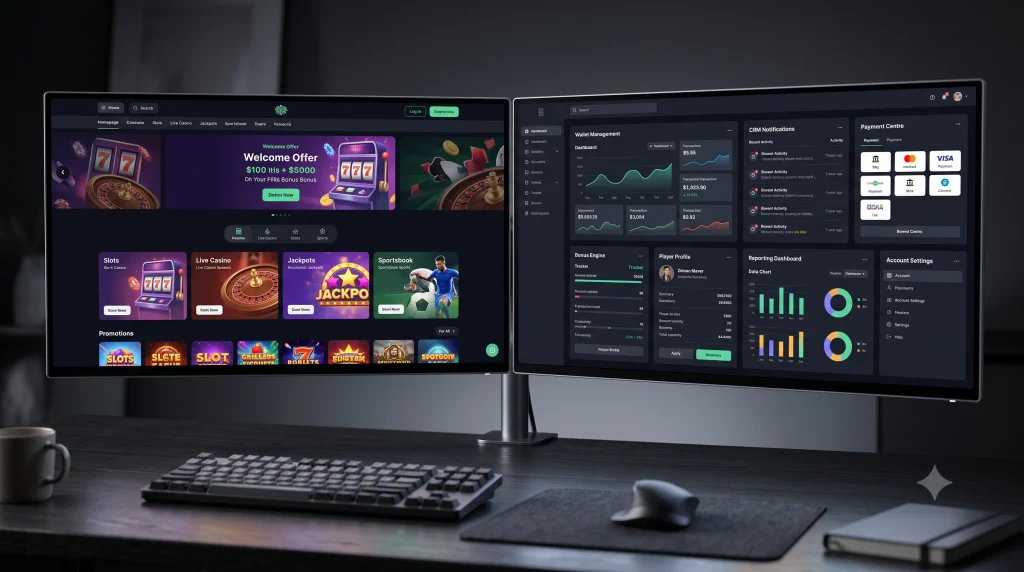
CRM and retention tools are often selected and integrated separately from the bonus engine and the PAM, then expected to work together as if they were designed as a unit. Whereas this sometimes works when the integrations are well-built, it more often produces exactly the kind of data silo described in the opening: systems that each do their job in isolation without giving the operator a coherent view of the player.
The platform infrastructure that enables real-time retention automation requires the CRM to receive wallet events, game session data, and deposit history from the PAM as they happen, not as a daily batch file.
Without that real-time feed, the CRM can’t trigger a re-engagement message when a player’s session ends without a follow-on deposit. It can’t suppress a bonus offer from a player who deposited two minutes ago through a channel the CRM hasn’t synced yet. The logic is straightforward; the infrastructure requirement is what most operators discover too late.
The bonus engine controls what promotional mechanics are available and how they’re applied. Welcome bonuses, free spin campaigns, cashback structures, wagering requirement tracking: these are table stakes.
What separates flexible bonus systems from constrained ones is the ability to configure rules at a granular level, whether targeting by player segment, jurisdiction, game category, or behavioral trigger, and the ability to do so without a development cycle. An operator who needs to wait two weeks for engineering to add a new bonus condition is not in a position to respond quickly to competitive pressure.
The loyalty and VIP layer sits on top of the CRM and requires both the player data history from the PAM and the campaign tooling from the CRM to function meaningfully. Tier management, point accumulation, and reward redemption are visible features.
The less visible requirement is that the system knows enough about each player’s behavior to make tier management feel personally relevant rather than administratively imposed. That requires data.
Retention is not a feature. It’s what happens when the CRM, bonus engine, and PAM are working together with enough data resolution to act on individual player signals. When they’re not connected, retention becomes a manual process.
Compliance Infrastructure, KYC, and Which Markets You Can Actually Enter
The compliance layer in an iGaming tech stack is often the one that determines whether a business can operate in its target markets at all. KYC verification, responsible gambling tools, AML reporting workflows, player data residency rules, and self-exclusion registry integrations: these are not optional additions.
They are conditions for holding a licence in most regulated markets, and the technical requirements vary significantly by jurisdiction. A platform that supports these functions generically may not support them in the specific way that a given regulator requires, which is a gap that surfaces during a licence application or a compliance audit, not during a product demo.
Along with the compliance layer sits the data infrastructure that makes audit reporting possible. Regulators require operators to produce transaction records, session histories, and betting data on demand and within defined timeframes.
Whether the platform generates those reports automatically, requires manual extraction, or depends on the vendor’s operations team to produce is an operational detail that carries real compliance risk. The operator who can’t produce a required report within the regulator’s window has a compliance failure on their hands regardless of whether the underlying data exists.

Analytics, Frontend Performance, and How the Stack Evolves After Launch
The analytics layer is where the data generated by every other part of the stack becomes usable for decisions. Real-time dashboards, player behavior tracking, revenue attribution, and campaign performance analysis: none of this is useful unless the underlying data pipelines are reliable and the reporting layer can answer the specific questions the team needs to ask.
An analytics tool that answers generic questions but can’t tell you which game categories drive the strongest 30-day retention for players who deposited under $50 in their first session is less useful than it looks in a product overview.
Frontend performance affects conversion in ways that show up clearly in data and are often underestimated during tech stack planning. Page load time, mobile rendering, lobby responsiveness under traffic load, and localization depth, meaning not just translated text but localized number formats, date conventions, and UX patterns, determine whether players stay or leave before they deposit.
A platform that performs well on a fast connection in a stable market may perform significantly worse in markets with slower average mobile speeds, and that difference directly affects the economics of player acquisition in those markets.
The data analytics capability of the stack also shapes how quickly the operator can act on what they learn. An analytics layer that requires a data analyst to write a query before a product team can test a hypothesis slows down iteration.
One that exposes self-service dashboards to non-technical stakeholders removes that bottleneck. The difference in decision speed, compounded over months, affects how quickly an operator can identify and act on player behavior patterns that competitors are also seeing.
Post-launch, the tech stack is never finished. Player volumes grow, new markets are added, regulatory requirements change, and new game formats appear. The operators who scale well are those whose initial stack was built with modularity in mind: components that can be swapped, upgraded, or extended without rebuilding the whole system. The ones who struggle at scale are those who chose the fastest available solution at launch without asking what happens when that solution hits its limits.
常见问题
What is the most critical layer in an iGaming tech stack?
The PAM is the foundation everything else connects to, though the critical layer depends on where the business is failing. An operator losing revenue to payment failures has a payment layer problem. One that can’t retain players despite strong acquisition has a CRM or data integration problem. The most important layer is whichever one is currently the binding constraint on growth, and that changes as the business evolves.
Can an operator build their own iGaming tech stack from scratch?
Yes, and some do. The realistic timeline for a purpose-built custom stack, from development through compliance certification and pre-launch testing, is 18-24 months and a budget well into seven figures. Most operators launching in a new market start with a white label or modular platform and migrate components to custom builds as revenue justifies the investment. The question isn’t whether to build or buy; it’s which components need to be proprietary to create competitive differentiation, and which are better sourced.
Do white label platforms include a complete tech stack?
Most include the core layers: PAM, game aggregation, basic payment processing, a bonus engine, and compliance tools. What they vary on is integration quality between layers, the flexibility of each component, and how much of the stack the operator actually controls. Two white label platforms that appear to cover the same component list can perform very differently in practice depending on how well those components are connected.
How does the tech stack affect player experience?
Directly and in multiple ways. PAM stability affects session reliability. Payment infrastructure determines whether deposits succeed on the first attempt. CRM integration quality determines how relevant promotional communications feel. Frontend performance determines whether a player gets to the game or leaves during loading. Analytics determines how quickly the operator identifies and fixes the parts of the experience that are losing players. Every layer touches player experience.
What should operators check when evaluating a tech stack vendor?
How data flows between layers in real time, not just whether the layers exist. Ask for a live demonstration of a CRM campaign being triggered by a wallet event from the PAM. Then check how quickly a new payment provider can be added, and whether compliance reporting is generated automatically or requires manual extraction from the vendor’s team. The quality of the integration between components tells you far more than the feature list of any individual component.
The iGaming operator tech stack isn’t a collection of tools. It’s a set of dependencies. The operators who understand those dependencies before they sign contracts are the ones who avoid rebuilding core infrastructure under live traffic.
Gamingsoft是领先的iGaming游戏聚合商,通过单一API集成,帮助娱乐城运营商连接200多家顶级游戏工作室。我们的GS Connect平台提供超过10,000款游戏的即时接入,涵盖老虎机、真人娱乐场、体育博彩和捕鱼游戏——无需与每家供应商单独洽谈。我们支持多币种、多语言,让运营商能够轻松快速地进入新市场。我们的技术团队全天候待命,确保平台运行始终稳定顺畅。无论您是要启动全新平台,还是扩展现有游戏库,Gamingsoft都能提供相应的工具与合作资源,助力您的业务加速增长。欢迎联系我们,了解我们能为您的业务带来哪些帮助。