An operator ran a reactivation campaign targeting players who had not deposited in the past thirty days. The campaign list was pulled from a static export the previous Monday. By the time the emails sent on Thursday, 23% of those players had already deposited through a mobile session earlier that week.
The CRM did not know. The wallet and the engagement platform shared no live connection. Reactivation messages reached active depositors, some of whom redeemed the attached bonus. The campaign spent more than it should have and converted fewer truly inactive players than the numbers suggested afterward.
The problem was not the campaign design. The offer was reasonable, the timing was considered, and the segment made sense in principle. What failed was the data layer underneath. A player who deposited Tuesday was still flagged as inactive on Thursday because the CRM had no way to see wallet events in real time.
That gap, between when something happens and when the CRM knows about it, is where most player management failures in iGaming actually live. It is not a segmentation problem. It is an architecture problem. And it is the central challenge that a properly built CRM API exists to solve.
What a CRM API Actually Does
At its core, a CRM API is an interface between the player engagement layer and every other system that produces or consumes player data. Its job is to make those systems talk to each other in real time, consistently, without requiring a human to export a spreadsheet and re-upload it somewhere else.
The simplest mental model: when a player deposits, the CRM API receives that event from the wallet immediately. The player’s segment updates. Any active campaign tied to that deposit event fires. If the player had been in a reactivation cohort, they are removed before the campaign sends. That full sequence, deposit to CRM update to segment refresh to campaign gate, should complete in under a second. In a batch-processed system, it might take 24 hours. That is the difference between a player data system that improves retention and one that generates noise.
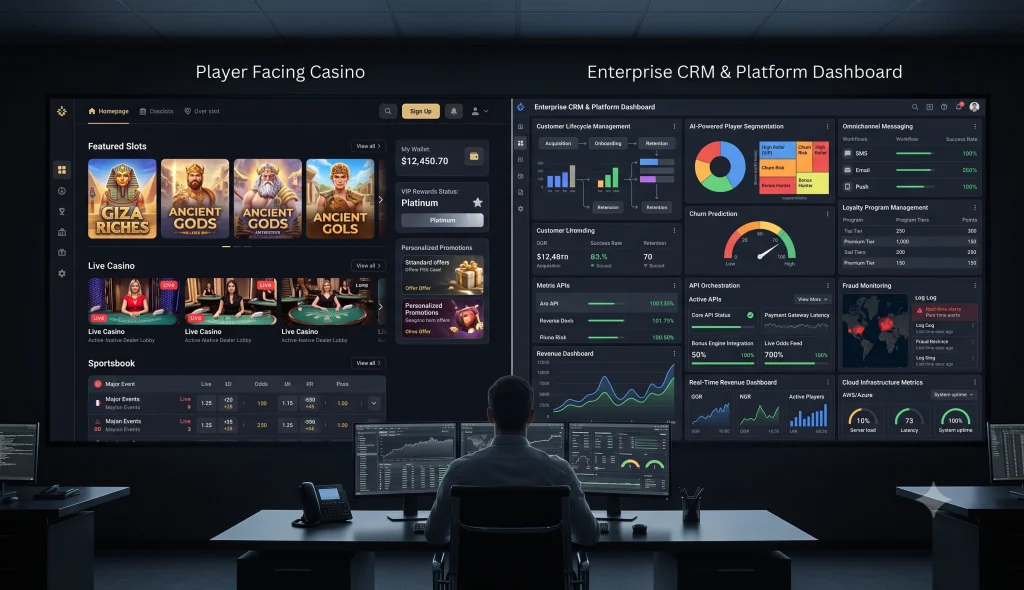
The components span several layers. The event ingestion layer captures actions as they happen: logins, deposits, game rounds completed, bonus claims, session endings. The player data layer stores the record for each account, covering registration data, transaction history, KYC status, game preferences, and whatever behavioral signals the platform tracks. A segmentation engine sits on top of that data and groups players dynamically based on current behavior, not last week’s export. Campaign management connects to that engine to trigger offers, assign bonuses, or route players into communication flows. The reporting layer ties it together.
Each of these layers needs to be connected. A CRM that has good segmentation logic but receives stale data will produce accurate-looking segments built on outdated information. That is arguably worse than no segmentation at all, because it gives operators false confidence in decisions that are wrong. Understanding what an iGaming platform actually consists of makes this clearer: the CRM is not a standalone product category. It is one layer of a stack that needs to stay synchronized across wallet, game aggregator, payment processor, and bonus engine at all times.

Why the Integration Problem Is Harder Than Most Operators Expect
The scenario above happens to operators who chose a reasonable CRM product and wired it up poorly, not because they chose the wrong tool. Almost every CRM platform marketed at iGaming operators can handle segmentation, lifecycle campaigns, and behavioral triggers. What none of them can do is solve an integration gap that was never addressed.
The most common version of this failure: the CRM is connected to the player database for registration data and KYC status, yet wallet events arrive through a nightly batch job. Game activity data is logged separately and feeds into the CRM every four hours. The bonus engine operates independently and does not notify the CRM when a player claims or completes wagering. The result is a system working from partial, delayed information. Campaigns fire late. Or they fire at the wrong players. Sometimes both.
Deposit events are where the integration gap does the most damage. If a reactivation campaign fires based on a player being inactive, but that inactivity signal updates every 24 hours, then players who deposited that morning will receive reactivation messages in the afternoon. Bonuses are sent to players who do not need them. The campaign reports strong delivery numbers and weak conversion. The true cause, stale data, is hard to see from the campaign analytics alone.
The payment API integration layer is typically where this breaks down first. Payments move through multiple processors on different timelines, and each processor needs to emit events back to the CRM immediately, not through a batch sync. Beyond payments, game round completions and session data also need to flow in real time if behavioral triggers are to work correctly. The infrastructure requirement here is closer to an event streaming system than a traditional database sync. Most operators discover this well after launch, when the architecture is already harder to change.
How Real-Time Event Processing and Segmentation Work
Event-driven architecture is the correct foundation for a player management API in iGaming. Rather than querying the player database on a schedule, the CRM subscribes to an event stream. When a player takes an action, an event is emitted. It is processed immediately, the player record is updated, segment membership is re-evaluated, and any campaign conditions that are now met are checked, all without human intervention.
Static lists have the opposite effect. A player’s status is frozen at the moment the list was built. New behavior does not change their segment until the list is refreshed. For operators with thousands of active sessions at any hour, a static list is out of date before it is ever used.
Dynamic segmentation works differently. Players are grouped continuously against live data. A player who deposits for the first time moves into the new depositor segment in real time. A player whose session length exceeds a threshold triggers a session limit recommendation immediately rather than being caught in the next batch run. A player who has not logged in for seven days enters the at-risk segment on day seven, not day eight when the batch job runs. The precision matters because the intervention window for each of these situations is narrow, and it closes fast.
Segmentation logic also needs to account for multiple products. An operator running both a casino and a sportsbook needs to track player behavior across both verticals and maintain a unified view. A player who is inactive on the casino side but highly active on sports is not an inactive player. A system that segments per-product without a unified identity layer will classify them as inactive and send reactivation messages to someone who is logging in daily. The way casino data analytics feeds into the CRM determines whether the segmentation is accurate or systematically misleading. Without a shared data layer, the two systems will disagree about basic facts.

Personalization, Campaign Automation, and the Player Lifecycle
Personalization in iGaming CRM is not about addressing a player by name in an email. It is about sending the right offer, through the right channel, at the point in the player’s session or lifecycle where it is most likely to produce a response.
The practical version looks like this: a player who typically deposits on Friday evenings receives a tailored match bonus offer on Thursday. A player who consistently plays slots but has never claimed free spin offers gets a targeted free spin campaign rather than a deposit match. A high-frequency player whose session length has been dropping over two weeks receives a personalized retention message, not the generic weekly promotional email that goes to the full base. None of these are complex scenarios. What they require is accurate, real-time behavioral data and the ability to act on it without manual campaign setup for each player.
Campaign automation handles the lifecycle side. An operator should be able to define a new depositor journey, triggered automatically on first deposit, that delivers a welcome sequence over the first two weeks, escalates to a VIP track at a defined spending threshold, and routes to a reactivation flow when inactivity is detected. The whole sequence should run without intervention once configured. Building this correctly means the campaign logic needs to be decoupled from the data layer, so that changes to one do not require rewriting the other.
Lifecycle management also means knowing when not to contact a player. A player who has self-excluded or set contact preferences should be excluded from all outbound communication automatically, including promotional campaigns, win notifications, and lifecycle triggers. The exclusion needs to be applied at the communication layer, not as a manual filter on individual campaign exports. When a player’s responsible gambling settings change, that change should propagate to the CRM immediately. Building infrastructure that scales with your player base requires this kind of propagation to be part of the data architecture from the start.
The difference compounds over time. VIP management is where it shows up most clearly. If a player crosses a spending threshold on Monday but is not moved to the VIP segment until Friday’s batch run, they may have already contacted support, hit a withdrawal limit, or churned before the VIP manager reaches out. The window matters. Treating it as a minor timing issue rather than a structural one is how operators lose players they spent significant acquisition budget to acquire.
Multi-Product and Multi-Market Complexity
A CRM API that works cleanly for a single-market, single-product operation becomes considerably more complex when the operator expands. The scope problem is the hardest part to plan for before it arrives.
The multi-product problem centers on identity. An operator running a casino, a sportsbook, and a poker room needs a single player record that tracks behavior across all three. Without a unified identity layer, three products produce three separate profiles that may not agree on basic facts. The player’s last login, total deposits this month, and segment membership will each read differently depending on which product’s data you look at. Campaigns built on inconsistent data produce inconsistent results. A player who is active on poker but churned from casino should not receive both a reactivation email and a loyalty reward in the same week.
Multi-market adds regulatory complexity on top of that. Player data handling, retention permissions, and communication consent rules differ across jurisdictions. GDPR requirements in Europe, data localization rules in specific markets, and player protection mandates around marketing exclusions all affect how the CRM can store and use player data. A single global player record that does not account for jurisdiction-specific restrictions will create compliance exposure as the operator grows. The architecture needs to support jurisdiction-aware data handling at the player level, not as a campaign-level filter applied at runtime.
Self-exclusion interoperability is one of the harder edge cases. An operator running multiple brands under the same license may be required to apply a self-exclusion across all brands simultaneously. If each brand’s CRM operates independently, that propagation needs to be wired explicitly. Missing it is a regulatory violation. It is also the kind of failure that is invisible in testing, yet surfaces when a player who self-excluded on one brand successfully deposits on another.
When evaluating iGaming platform vendors, the CRM API’s approach to multi-product identity and jurisdiction-aware data handling is one of the more revealing questions to ask. Vendors who describe it as a configuration option rather than a core architectural feature are describing a system that will need significant custom work when expansion happens, and expansion tends to happen faster than operators expect.
Frequently Asked Questions
What is a CRM API for online casinos?
A CRM API is a programmable interface that connects the player engagement layer with every system that produces or consumes player data: the wallet, the game platform, the bonus engine, and the communication channels. Rather than managing player data through manual exports and uploads, the API allows these systems to exchange information in real time. When a player deposits, self-excludes, or crosses a behavioral threshold, the CRM knows immediately and can trigger the appropriate campaign or restriction without manual intervention.
Why does real-time data matter for casino CRM?
Player behavior moves faster than batch-processed systems can track. A player who deposited Tuesday morning can receive a reactivation message that same afternoon if the CRM’s inactivity data is twenty-four hours stale. A player who self-excludes at noon can receive a promotional email at 1pm if the exclusion has not propagated to the communication layer. Real-time synchronization between the wallet, the CRM, and the communication channels prevents these failures, yet it requires event-driven architecture rather than database polling, and most operators do not build it that way from the start.
How does segmentation work in a CRM API?
Dynamic segmentation evaluates each player’s membership in defined groups continuously, based on live behavioral data. A player moves into the at-risk segment when their activity drops below a defined threshold, not when the next scheduled batch job runs. A new depositor enters the onboarding lifecycle immediately, not at the next hourly sync. The value of this is that campaigns fire when the behavioral signal is fresh, not after a delay that reduces the likelihood of a response.
What systems does a CRM API need to integrate with?
At minimum: the wallet for deposit and withdrawal events, the game platform for session and round data, the bonus engine for campaign triggering and completion tracking, and the communication channels for email, SMS, and push delivery. For multi-product operators, a unified identity layer is needed to reconcile player records across verticals. For multi-market operators, jurisdiction-aware data handling needs to be part of the player record structure rather than applied as a filter at the campaign level.
What is the biggest mistake operators make when implementing a CRM API?
Treating integration as a post-launch task. The CRM is typically connected to registration data and basic KYC fields during initial setup, with wallet events, game data, and bonus engine connections deferred to later. By the time behavioral campaigns are needed, those integration gaps are already embedded in the architecture and harder to fix. Defining all event sources and data flows before platform launch, and wiring them in as part of the initial build, avoids the retrofitting cost that otherwise arrives at the worst possible time.
How should operators evaluate CRM API vendors?
The most important question is not about feature lists. It is about data flow: how quickly does a wallet event reach the CRM, how is player identity maintained across products, and how does the system handle jurisdiction-specific data restrictions. Vendors who can answer these concretely, with real latency numbers and documented integration patterns, are describing systems that have been tested under production load. Vendors who respond with marketing language about personalization and AI are often describing capabilities that depend on integration work they have not yet scoped.
A CRM API is only as good as the data feeding it. The segmentation logic and campaign tooling matter far less than the event infrastructure underneath. Operators who get the integration right run more targeted campaigns at lower cost; those who do not spend more on broader sends that convert at lower rates, often without a clear view of why.