A sports betting operator launched in Southeast Asia using a white label sportsbook. Six weeks from contract to go-live. The platform covered all the basics: pre-integrated odds feeds, a risk management layer, payment processing, and a frontend they could skin with their brand.
Within nine months, they were doing $220,000 in monthly GGR. Then the provider revised their revenue share terms upward. Six months after that, the operator wanted to add a local cash voucher payment method that the platform did not support. The custom development quote to add it came back at $90,000 and a six-month wait. Moving to a new platform entirely was quoted at $380,000.
None of this had been hidden from them. The constraints were in the contract. What they had read was the speed-to-market benefit; what they had not read closely enough was everything past it.
White label vs custom sportsbook is often framed as a binary question: which is better? That framing misses the point. Both models work. Each carries a specific set of trade-offs that fit a specific operator profile at a specific stage of growth. Choosing well means understanding those trade-offs before you sign, not discovering them after you scale.
What a White Label Sportsbook Actually Gives You
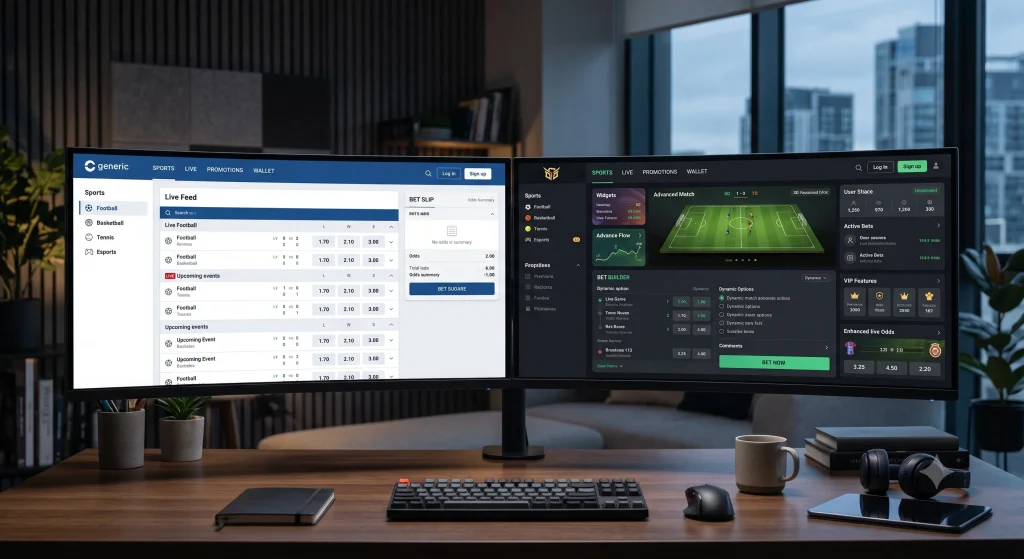
A white label sportsbook is a pre-built platform licensed from a third-party supplier, where the operator gets access to a running system rather than owning one outright. What gets handed over typically includes an odds aggregation layer, a risk management engine, settlement logic, a back-office CMS, and basic payment processing. Deployment timelines in the range of four to eight weeks are realistic because the core infrastructure is already operational.
What the model does not give you is unconstrained product control. The provider owns the platform roadmap. New features get built when the provider builds them, not when the operator requests them. Betting markets, odds formats, and payout structures are available to the extent the platform supports them, yet operators who need something outside the standard configuration often find themselves in a queue or facing a custom development charge. These are not failures of the model. They are properties of it.
A useful reframe: think of white label as renting a fully furnished apartment. You can move in immediately, everything works, and maintenance is handled for you. But you can’t knock down walls.
What Custom-Built Actually Means for a Sportsbook
A custom sportsbook is software built specifically for one operator’s business, whether developed in-house or through a technical partner. The distinction from white label is ownership: the operator owns the codebase, controls the roadmap, and makes the product decisions. Proprietary odds systems are possible, unusual betting market structures can be built, UX flows can be designed around a specific player base, and third-party integrations are limited only by engineering capacity.
The cost that catches operators off guard is not the development fee. Development budgets for a proper custom sportsbook build run from $500,000 on the low end to well above $1 million for more sophisticated systems, though the more surprising cost is time. Certification, compliance review, and pre-launch QA testing can add four to eight months beyond initial development timelines. API-based modular solutions have emerged partly in response to this: they sit between the two models, giving operators more control than a turnkey platform without the full overhead of a bespoke build.
Cost Structure: What the Quote Doesn’t Include
White label pricing tends to look simple on the surface: a setup fee, a monthly platform fee, and often a revenue share percentage applied against GGR. The revenue share is the component operators consistently underweight. At 15-20% of GGR, that line item scales directly with the operator’s success. It might feel manageable at $100K monthly GGR; at $800K it reframes the entire business case for keeping the arrangement.
What’s also frequently undisclosed upfront: fees for adding new payment providers, costs for compliance updates in new jurisdictions, the pricing for custom integration work, and any minimum volume guarantees that lock the operator into spending regardless of performance. Payment orchestration adds another layer of cost complexity, since white label providers vary significantly in how much PSP flexibility they actually support versus what their sales team implies. The total cost of ownership over 36 months is a more honest comparison point than the setup fee alone.
Custom build costs are front-loaded whereas white label costs are distributed. That distinction matters significantly depending on the operator’s capital position. A well-funded operator with a long-term view and a target market that requires product differentiation may find the math tilts toward custom well before month 24. For a capital-constrained operator entering a new market to test viability, white label is far more sensible, even knowing the unit economics look less attractive at scale.
The 36-month view is the right unit of analysis. Most operators who feel burned by their platform decision were comparing setup costs, not total costs.
Speed, Compliance, and What Launch Timeline Actually Means in Practice
Launch timelines on a white label sportsbook are genuinely fast. Four to eight weeks is achievable because the regulatory-facing infrastructure, reporting systems, KYC pipelines, and responsible gambling tools are part of the provider’s existing platform and have already been certified in relevant jurisdictions. The operator’s compliance obligation shifts from building these systems to configuring them and meeting any jurisdiction-specific requirements on top.
Custom builds carry full compliance responsibility in-house. AML workflow design, player data residency configuration, RNG certification where applicable, and reporting format compliance for each licensed jurisdiction all fall to the operator’s team. Along with the longer development timeline, this layer adds meaningful pre-launch overhead. Operators who underestimate it typically discover the gap between “development complete” and “approved to go live” is longer than they planned.
Speed matters most in specific situations: a time-limited market window, a licensing deadline, or a competitive environment where being second to a market costs significantly more than building faster. In markets with longer lead times or where the operator’s edge is genuinely product-differentiated, the speed argument for white label matters less, and the product flexibility argument for custom becomes more relevant.

When to Choose Which Model, and When to Migrate
White label makes sense when the operator is entering a new market without an established player base, when capital is constrained or the business model is still being validated, or when time to market is genuinely the deciding factor in whether an opportunity closes. The ready-made platform absorbs technical risk and compliance complexity during the period when the operator is focused on proving the market, not perfecting the product.
Custom makes sense when the operator has a working business with a validated player base and the revenue share or platform constraints are visibly limiting growth. It also makes sense from day one for operators with a specific product differentiation that can’t be replicated on a standard platform: proprietary risk models, unusual market structures, deeply localized UX, or regulatory requirements that no existing white label provider has certified for. For those operators, the speed advantage of white label evaporates quickly because the custom work they need cannot be done on someone else’s platform anyway.
The hybrid path is worth understanding. Some operators run white label for their core sports betting product and integrate modular components on top: a custom CRM, a proprietary bonus engine, or a payment layer with PSPs their white label provider won’t support. This approach buys speed at launch while preserving some product control. It’s not without complexity, and the integration overhead is real, yet for operators who need to launch fast but know they’ll need specific custom components, it avoids the all-or-nothing framing.
Migration from white label to custom is possible and happens regularly. The common failure mode is doing it reactively: waiting until the white label constraints become painful before starting the planning. A migration well executed takes 12-18 months from decision to go-live. The onboarding checklist considerations that apply to white label at launch apply in reverse during migration: player data portability, wallet balances, active bonus positions, and active sessions all need handling, and not all white label providers make this easy by design.
Don’t wait for the pain to start planning the exit. Launching faster without sacrificing quality is a goal that applies equally to initial go-live and to platform migrations. Operators who treat migration as something they’ll figure out when they need it consistently underestimate the timeline and cost.
Frequently Asked Questions
Is a white label sportsbook profitable?
Yes, particularly in the early stages when the revenue share cost is outweighed by the speed and capital advantages. Profitability on a white label depends heavily on the GGR-to-revenue-share ratio at scale, and operators who don’t model that ratio across 24-36 months sometimes find the model less attractive than it appeared at launch.
How long does it take to build a custom sportsbook?
Plan for 12-18 months from project start to go-live for a properly built custom platform. Development typically accounts for six to nine months; the remainder is certification, compliance work, QA testing, and pre-launch staging. Operators who plan for nine months and end up needing fifteen are common. The ones who plan for eighteen and ship in fourteen are less stressed about it.
Can I switch from white label to custom later?
Yes. Most operators who go custom started on a white label platform. The migration requires careful planning around player data, wallet balances, active session handling, and third-party integrations, along with your provider’s willingness to support the exit. Build that migration plan before you need it.
Do white label sportsbooks include odds feeds?
Most do, along with pre-integrated risk management. The quality and depth of market coverage varies significantly between providers.
What’s the biggest mistake operators make when choosing between the two?
Choosing on setup cost rather than total cost of ownership. A white label at $50,000 to launch that costs $180,000 per year in revenue share at modest GGR levels has a very different 36-month profile than that $50,000 figure implies. Model the full cost across the business plan horizon, not just the launch invoice.
The white label vs custom sportsbook decision is really a question about what your business needs right now and what it will need in two years. Getting that staging right, including knowing when to transition, matters more than which model you pick.
Gamingsoft is a leading iGaming aggregator connecting casino operators with over 200 top-tier game studios through a single API integration. Our GS Connect platform provides instant access to more than 10,000 games across slots, live casino, sports betting, and fishing games — without requiring separate negotiations with each provider. We support multiple currencies and languages, making it simple to enter new markets quickly. Our technical team is available around the clock to ensure seamless platform performance. Whether you are launching a new platform or expanding an existing game library, Gamingsoft has the tools and partnerships to accelerate your growth. Get in touch to learn what we can do for your business.