A slot lobby assembled in 2026 doesn’t struggle to fill space. The challenge most operators face isn’t sourcing enough games; it’s identifying which providers actually move retention metrics rather than just padding game counts. Across 200+ providers available through aggregator platforms today, the studios that earn long-term portfolio allocation are those whose games do measurable work on session frequency and player lifetime value. That’s the category where Quickspin competes, and it’s the commercial frame through which any serious operator evaluation should start.
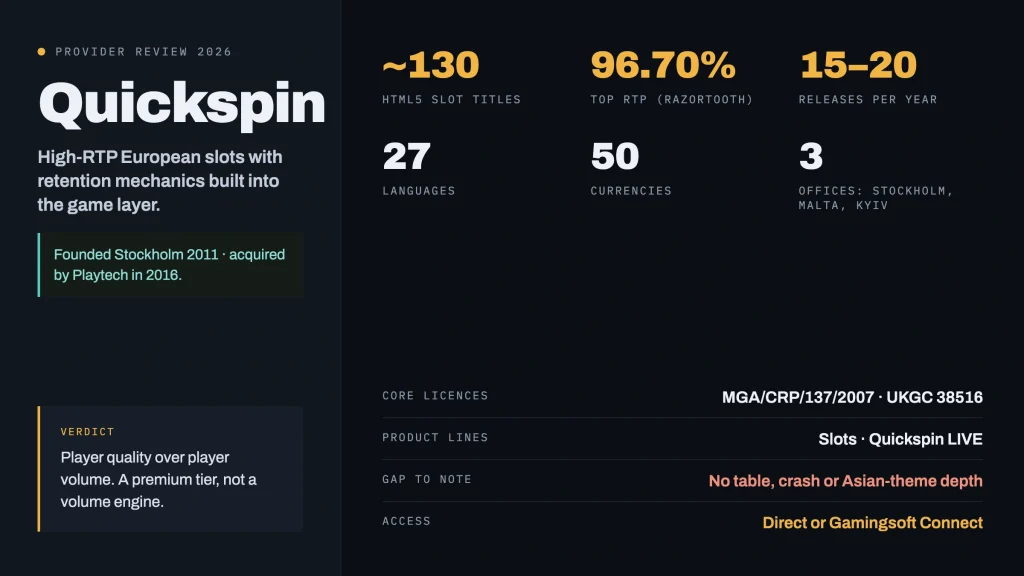
Quickspin’s catalogue sits at roughly 130 titles at the time of writing (official, quickspin.com portfolio page). That’s well below the release velocity of Pragmatic Play or NetEnt. What sets the studio apart isn’t scale; it’s a consistent approach to embedding retention mechanics directly into game design, an approach built since founding in Stockholm in 2011, and continued under Playtech’s ownership following the 2016 acquisition (public record). Founders Daniel Lindberg, Joachim Timmermans, and Mats Westerlund came predominantly from NetEnt, and the studio has carried that engineering discipline into every major product decision since.
This review covers game portfolio, operator tools, technical integration, commercial access terms, and where Quickspin earns its place, or doesn’t, in a modern operator lobby.
Integrate Quickspin with Gamingsoft Today
Quick Verdict: Quickspin is best suited to operators competing on player quality rather than player volume, particularly those targeting experienced slot players who respond to mechanical depth and high base RTPs. It’s not an ideal primary provider for lobbies built around high content volume or Asian-themed game catalogues. Operators without an existing direct B2B relationship can access the full Quickspin catalogue via Gamingsoft Connect, alongside 200+ providers through a single API integration, without needing to negotiate a standalone direct deal.
Quickspin’s Position in the Market
Quickspin occupies a specific part of the premium European slot market: quality-driven, moderate release volume, with consistent recognition from operators who compete on player lifetime value rather than acquisition velocity. Its parent company, Playtech, is one of the largest publicly listed gaming technology companies globally, and Quickspin benefits from that group’s infrastructure, compliance support, and distribution reach while maintaining its own creative identity and release cadence (public record, Playtech plc filings).
EGR B2B Awards recognition including Rising Star, Game of the Year, and Social Gaming Supplier categories reflects the studio’s standing in the operator community (public record, EGR publications). More practically, Quickspin games appear reliably on premium bonus landing pages and high-RTP lobby filters because they perform at player level across multiple sessions, not just on first exposure.
The studio has expanded its offering beyond pure slots. Quickspin LIVE now provides a live casino product line, including Big Bad Wolf LIVE, extending its most recognisable IP into the live dealer format. That expansion gives operators a cross-vertical promotional hook, though slots remain the core of what Quickspin does.
Game Portfolio and Key Titles
Quickspin’s portfolio covers approximately 130 HTML5 slot titles, with live casino as a growing secondary category (official, quickspin.com). There are no table games, crash games, or sports data products. The offering is slot-first, deliberately so, and that focus shows in the per-title production consistency.
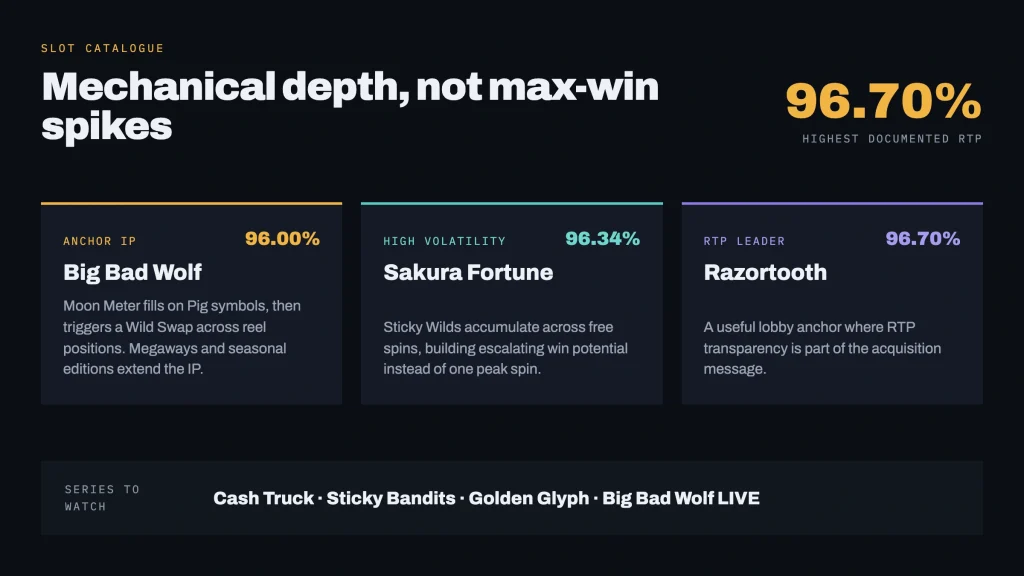
Big Bad Wolf remains the studio’s original commercial anchor. Its Moon Meter mechanic fills as Pig symbols land on reels, eventually triggering a Wild Swap feature that converts multiple reel positions to wild. The game carries an RTP of approximately 96.00% (industry-reported) and continues to appear consistently across European-licensed lobby shortlists. A Megaways variant and seasonal editions exist, expanding the IP without displacing the original’s position.
Sakura Fortune built Quickspin’s reputation in the high-volatility segment. Sticky Wilds accumulate across free spin rounds, creating escalating win potential rather than a single-spin peak. Reported RTP sits at approximately 96.34% (industry-reported). Razortooth carries the highest documented RTP in the catalogue at approximately 96.70% (industry-reported), making it a useful anchor for operators whose player acquisition messaging includes RTP transparency as a trust signal.
The Cash Truck series, Sticky Bandits franchise, and Golden Glyph series represent Quickspin’s more recent expansion into higher-volatility territory. These titles target the same player segment as competitors’ max-win-focused releases but maintain mechanical depth rather than reducing variance to a single high-multiplier event. Operators tracking game performance metrics will want to assess whether that design approach matches their player base. Understanding how operators measure game performance at the portfolio level is covered in detail in what makes a game perform well: key metrics operators should track.
Quickspin releases approximately 15 to 20 titles annually (industry-reported). For operators running high-volume “new games” lobby rotations that require 40+ fresh titles per year, the release cadence won’t meet that requirement. That trade-off is worth naming explicitly, because it shapes where Quickspin belongs in a portfolio strategy. The broader argument around content volume versus quality is examined in more games, more problems: the truth about content expansion in iGaming.
All titles are built in HTML5 and compatible across desktop and mobile browsers without plugin dependencies. Mobile rendering is consistently strong at mid-range device specifications, with Achievements and Missions UIs specifically optimized for smaller viewports.
Technical Infrastructure and Integration
Quickspin delivers its catalogue via a B2B API integration model. Games are certified for HTML5, built to standard iGaming protocols, and carry RNG certification as a condition of its regulatory licences. The studio operates from offices in Stockholm, Malta, and Kyiv. A dedicated Client Area provides operator-level access to game assets, documentation, reporting tools, and feature configuration.
Regulatory certifications held by Quickspin include: Malta Gaming Authority (MGA), Critical Gaming Supply Corporate licence MGA/CRP/137/2007, issued 06 December 2018 (official, quickspin.com); Great Britain Gambling Commission (UKGC), account number 38516 (official, quickspin.com); Spelinspektionen in Sweden; KSA in the Netherlands; and licences covering Denmark, Italy, Romania, Portugal, Isle of Man, and Gibraltar (industry-reported, operator-facing documentation). For operators targeting regulated European jurisdictions, the coverage is comprehensive. Beyond Europe, jurisdiction-specific approval status requires verification at the operator compliance level.
Bonus buy features are available where jurisdictionally permitted and can be enabled or disabled per market. Games are available in 27 languages and 50 currencies (industry-reported), giving operators meaningful configuration options for multilingual player bases. Operators assessing integration requirements should review how the casino game API works and what to look for before beginning vendor discussions and the game provider due diligence framework for a structured evaluation checklist.
Commercial Terms and Access Options
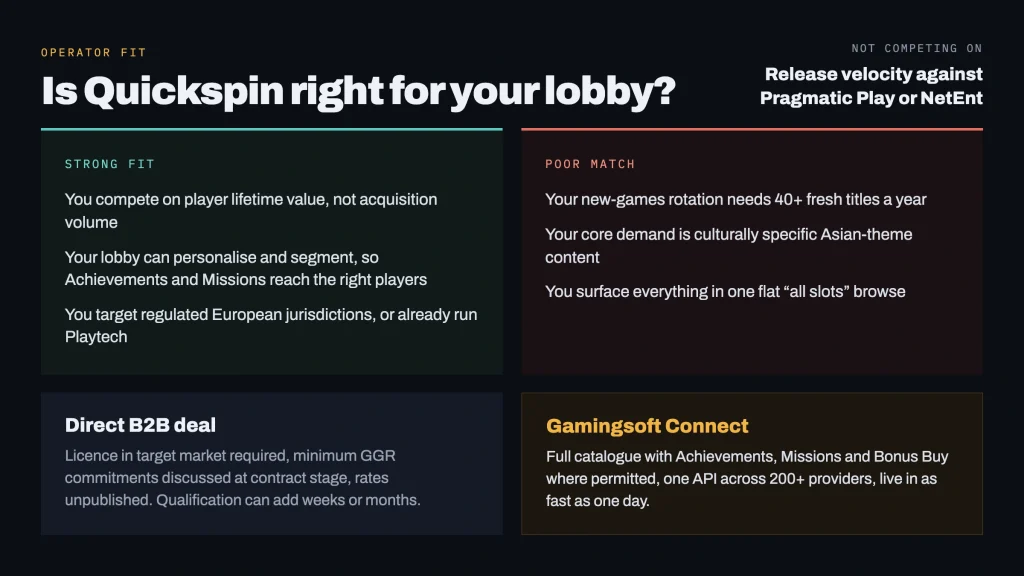
Direct B2B agreements with Quickspin require operators to hold a relevant gaming license in their target jurisdiction and typically involve minimum GGR commitment discussions at the contract stage. Revenue share structures are not publicly listed; terms vary by operator scale, market, and existing Playtech group relationships. Industry-reported base rates for premium European slot providers generally fall in the range of 10-25% GGR (industry-reported; actual terms vary by operator profile, volume, and commercial relationship). For operators new to direct provider negotiations, how to negotiate contracts with casino game providers provides a practical framework for what to expect.
Direct deals also carry lead time. Operators without an existing Playtech group relationship, or those without established GGR history to present at the negotiation stage, face a qualification and contracting process that can extend the go-live timeline by weeks or months.
Accessing Quickspin via Gamingsoft Connect
Gamingsoft Connect aggregates 200+ providers, including Quickspin, through a single API integration. Startup operators who don’t yet have direct provider relationships can access Quickspin’s full catalogue, including Achievements, Missions, and Bonus Buy features where applicable, without negotiating a separate direct deal with Playtech or Quickspin. Existing casino operators adding Quickspin can do so without rebuilding their existing integration infrastructure.
For operators targeting markets outside Europe, Gamingsoft’s multi-currency and multi-language configuration extends Quickspin’s European-licensed catalogue into international market contexts. CDN solutions for China-region accessibility, seamless wallet integration, and multi-brand management are available through the platform. Standard setup via Gamingsoft can go live in as fast as 1 day for standard configurations, which is a substantially different timeline from completing a standalone direct provider agreement. Operators can review the Quickspin catalogue and request demo access before committing to go-live.
This access path works for the operator who understands how casino game providers integrate with platforms and wants to avoid rebuilding that infrastructure provider by provider.
Is Quickspin Right for Your Casino?
Quickspin is a strong fit for operators whose player base prioritises mechanical depth and high base RTP over theme novelty or sheer game volume. The studio’s Achievements and Missions toolset is built for experienced slot players who return to games across multiple sessions rather than chasing a single session win. Operators whose retention strategy depends on player lifetime value rather than acquisition volume will find the design philosophy directly relevant.
To extract the most from Quickspin’s differentiators, an operator needs some lobby personalisation capability to direct Quickspin titles toward higher-value player segments. Surfacing them in a flat “all slots” browse dilutes the mechanical advantages and prevents the studio’s design logic from translating into measurable outcomes. Without that segmentation layer, Quickspin sits in the portfolio but doesn’t do the job it’s built for.
Compared to NetEnt, which carries a larger catalogue and stronger brand recognition across casual player segments, Quickspin’s portfolio is smaller but more mechanically consistent per title. Against Play’n GO, which pursues a similar quality-first positioning, Quickspin’s operator toolset through Achievements and Missions is deeper, though Play’n GO’s theme range is more culturally diverse. Neither comparison is a clean verdict; both are trade-offs that depend on player segment.
Operators whose primary focus is a high-volume Asian-theme catalogue should evaluate alternatives first. Quickspin’s game themes and mechanics are European-weighted and don’t carry the same organic traction with players who primarily want culturally specific Asian designs. That said, Quickspin can function effectively as a premium supplementary tier in a broader portfolio that already covers Asian-facing content through other providers.
Operators building their first casino platform, or those without an established GGR history to present to direct providers, can still access Quickspin’s full catalogue through Gamingsoft Connect without the qualification requirements a standalone direct agreement demands. For operators already running Playtech as a core provider, evaluating Quickspin as a group brand extension makes particular commercial sense. And for live casino technology context relevant to the Quickspin LIVE product, live casino technology explained covers the infrastructure decisions operators need to understand.
Frequently Asked Questions
What makes Quickspin different from other European slot providers?
Quickspin’s primary differentiator is the combination of in-game operator tools, specifically Achievements and Missions, with a consistently high-RTP catalogue. Most European slot studios focus on game mechanics alone. Quickspin builds structured retention mechanics into the game layer itself, which means player engagement systems activate through normal gameplay rather than requiring operator-side CRM campaigns to deliver them.
Is Quickspin suitable for startup casino operators?
It can be, with the right access path. Startup operators without an existing direct provider relationship can access Quickspin’s full catalogue through Gamingsoft Connect without needing an established GGR history or a direct Playtech group relationship. The studio’s game complexity works best with experienced player segments rather than casual first-depositor lobbies, so lobby positioning still matters even when access isn’t the barrier.
Can operators access Quickspin without a direct deal?
Yes. Quickspin is available through Gamingsoft Connect, which provides the full Quickspin catalogue alongside 200+ providers via a single API. The Achievements and Missions toolset, Bonus Buy features where jurisdictionally permitted, and standard game content are all included. Operators don’t need to rebuild existing platform infrastructure to add the studio this way.
What regulatory certifications does Quickspin hold?
Quickspin holds an MGA Critical Gaming Supply Corporate licence (MGA/CRP/137/2007, issued 06 December 2018) and is regulated by the UK Gambling Commission under account number 38516. The studio also holds Spelinspektionen certification in Sweden, KSA approval in the Netherlands, and licences covering Denmark, Italy, Romania, Portugal, Isle of Man, and Gibraltar.
How many games does Quickspin release per year?
Approximately 15 to 20 titles annually (industry-reported). This is substantially lower than high-volume studios like Pragmatic Play. The studio’s position is quality-per-title rather than release frequency, and the portfolio strategy reflects that deliberately.
How does Quickspin compare to Pragmatic Play for operators?
Pragmatic Play offers higher release volume, broader theme diversity including culturally-specific Asian titles, and stronger name recognition in mass-market player segments. Quickspin offers deeper per-title mechanics, higher average RTP, and a more targeted retention toolset through Achievements and Missions. The two aren’t direct substitutes; operators who carry both typically position them at different player segments within the same lobby.
What is the Quickspin LIVE product?
Quickspin LIVE is the studio’s live casino product line, built around its most recognisable slot IPs. Big Bad Wolf LIVE is the flagship title, extending the slot brand into a live dealer format. For operators looking to cross-promote across slot and live casino verticals using consistent brand assets, the Quickspin LIVE catalogue provides a bridge between those two product areas.
Quickspin’s value to an operator doesn’t come from library size. It comes from what the games do to session frequency and player return rates over time, and whether the operator’s lobby strategy can direct those titles toward the players who’ll actually respond to mechanical depth. That’s the question worth answering before any integration decision gets made.