An operator building a casino lobby for Chinese-speaking players in 2026 faces a very specific content problem. Standard slot catalogues from European studios don’t move the metrics for this audience the way traditional card games do. Players who grew up with Mahjong, Dou Dizhu, and Texas Hold’em in Chinese-language formats expect those experiences on any platform they use, and they leave fast when a lobby doesn’t deliver them.
Kaiyuan Gaming, known as 开元棋牌 (KY) in Chinese markets, positions itself as a card game interface platform built specifically for this segment. The studio’s catalogue centers on traditional Chinese chess and card game formats, fishing games, and electronic titles, designed for Chinese-speaking players rather than adapted from Western slot frameworks (industry-reported, multiple operator platform sources). The official platform carries the subtitle 开元棋牌, which translates directly as “Kaiyuan Chess and Card Games,” a name that signals product identity without ambiguity.
This review covers what Kaiyuan brings to the game lobby, who the provider fits, and how operators can access the catalogue through direct and aggregator channels.
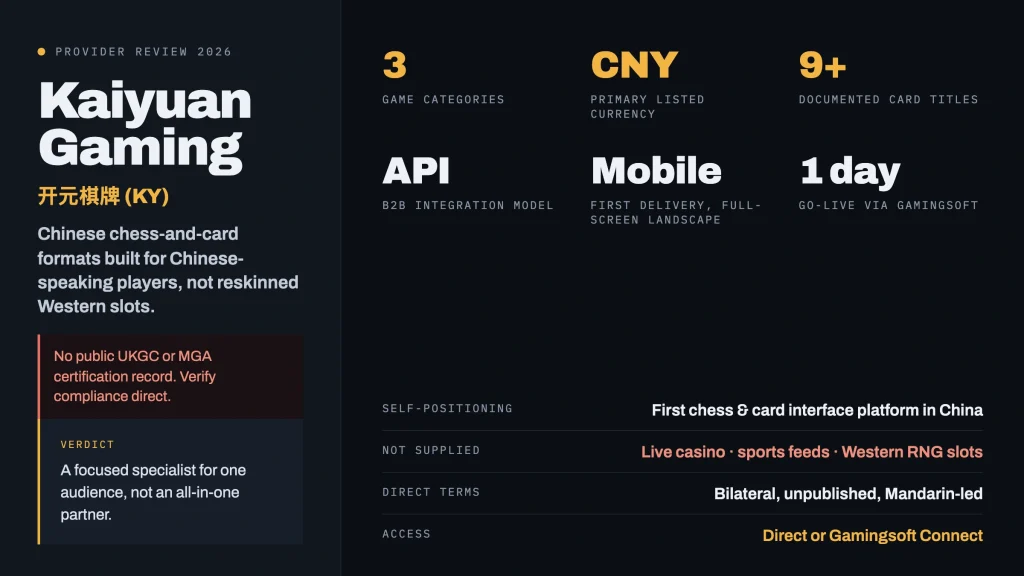
Quick Verdict: Kaiyuan Gaming is best suited to operators targeting Chinese-speaking player segments who want authentic Chinese-format card game content: Mahjong, Dou Dizhu, Niu Niu, fishing games, and related titles, built for how those players actually play, not reskinned Western mechanics. It’s not a fit for operators building European-style slot lobbies or those whose player base primarily wants RNG video slots. Operators can access Kaiyuan through Gamingsoft Connect alongside 200+ other providers via a single API integration, without needing a direct bilateral agreement with the studio.
Kaiyuan’s Position in the Market
Kaiyuan Gaming is documented in its API integration materials as “the first chess and card leisure game interface platform in China” focused on the global Chinese game market (industry-reported, neapi.com API platform documentation). The provider’s core positioning is around traditional Chinese-format card and board games, a category distinct from Western-style slot development and underserved by major European providers.
The Chinese name 开元棋牌 (literally “Kaiyuan Chess and Cards”) signals the product identity directly to its intended audience. This isn’t a provider that pivoted into Asian themes as a market expansion play; the platform was built from the ground up for Chinese card game formats. That distinction matters commercially. Games designed by people who understand the session dynamics, social elements, and play conventions of Chinese card formats perform differently in those player segments than Asian-aesthetic adaptations of standard Western slot mechanics.
The platform primarily supports CNY as its operating currency (official, Gamingsoft provider listing), reinforcing its positioning within Chinese-speaking operator environments rather than multi-regional mainstream markets.
Game Portfolio and Key Titles
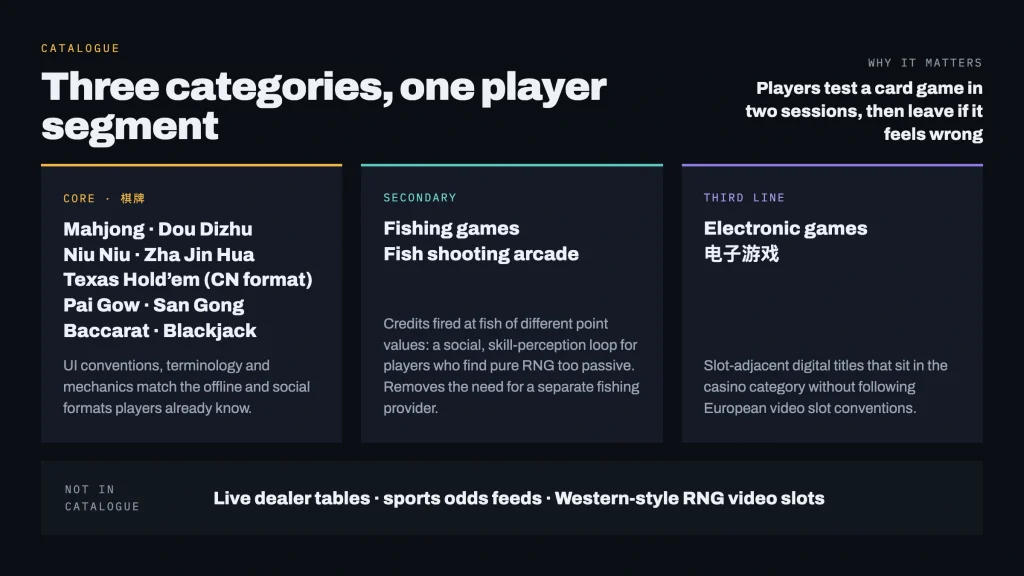
Kaiyuan’s catalogue spans three primary game categories, each targeting a different segment of the Chinese-speaking player base.
Card and board games form the studio’s core product line. Texas Hold’em in Chinese-language format, Mahjong (two-player and multiplayer variants), Dou Dizhu (Landlord), Niu Niu (Bull Bull), Baccarat, Blackjack, Pai Gow, San Gong, and Zha Jin Hua (Golden Flower) are among the documented titles (industry-reported, operator platform sources). These aren’t superficially relabeled Western games; the UI conventions, terminology, and mechanic structures are built to match the formats Chinese-speaking players know from offline and social gaming contexts. That authenticity is the commercial differentiator: players in this segment will test a card game within two sessions and abandon it if it doesn’t feel right.
Fishing games sit alongside the card catalogue as a meaningful secondary category. Fish shooting titles blend arcade mechanics with gambling outcomes: players spend credits firing at fish with different point values, creating a social, skill-perception experience that performs well in Chinese-speaking market contexts where pure RNG slots feel too passive.
This category has grown steadily as a lobby differentiator for operators targeting Chinese-speaking players, and Kaiyuan’s coverage here reduces the need for a separate dedicated fishing game provider. Operators evaluating this genre should review top iGaming game categories by market for context on where fishing games sit in regional player preference data.
Electronic games (电子进戏) round out the offer, covering slot-adjacent titles that fit the digital entertainment casino category without mapping to European-style video slot conventions.
What the catalogue does not include: Kaiyuan is not a live casino provider, does not supply sports data or odds feed products, and doesn’t produce standard Western RNG video slots. For operators needing those categories, Kaiyuan functions as a focused specialist rather than an all-in-one content partner. Understanding the trade-offs of content volume versus specialist depth is worth reviewing in more games, more problems: the truth about content expansion in iGaming.
Technical Infrastructure and Integration
Kaiyuan operates as a B2B game platform with API-based integration for operator partners (confirmed, neapi.com KY API interface documentation). The stated design goal is to reduce operator development cost while improving product competitiveness and user activity in the Chinese-speaking player segment (industry-reported, Kaiyuan platform API materials).
The platform is built for mobile-first delivery, consistent with Chinese-speaking market requirements where mobile gaming is the dominant access mode. Technical specifications from the official platform include full-screen mobile support, landscape orientation, and cross-platform compatibility (official, yl.ishxu648.com page metadata). These aren’t luxury features for this provider’s primary market; they’re table stakes.
Regulatory certification details for Kaiyuan Gaming are not publicly documented in English-language regulatory databases. Operators in jurisdictions requiring certified game content (including UKGC and MGA-regulated markets) must verify compliance status directly with the provider before integration.
This is a standard consideration for regional Chinese game providers whose primary markets include less-regulated gaming environments. Operators assessing this as part of their integration process should apply a structured game provider due diligence framework and review how casino game API works and what to look for before engaging technically.
Commercial Terms and Access Options
Direct integration terms with Kaiyuan Gaming are not publicly listed in English-language documentation. The provider operates primarily through API-based licensing arrangements negotiated bilaterally, and those discussions predominantly happen in Chinese-language contexts given the studio’s primary market orientation (industry-reported).
Revenue share structures and minimum commitments vary by operator profile, as is standard for regional providers of this type. Operators without existing relationships or Chinese-language capacity in their business development function will find the direct route carries meaningful lead time and coordination requirements.
Accessing Kaiyuan via Gamingsoft Connect
Gamingsoft Connect aggregates 200+ providers, including Kaiyuan Gaming, through a single API integration. Operators who want to add Chinese card game content without negotiating a separate direct agreement, or who want to trial the Kaiyuan catalogue before committing to a bilateral deal, can do so through the aggregator route without rebuilding their existing platform infrastructure.
This matters most for startup operators new to Chinese-facing game content who may lack the provider relationships or language resources to negotiate directly with a Chinese-language-first studio. Gamingsoft’s CNY support and multi-currency configuration extend Kaiyuan’s content into operator environments that have already set up seamless wallet integration and back-office management. CDN solutions for China-region accessibility and multi-language configurations through Gamingsoft also pair naturally with Kaiyuan’s audience requirements.
Standard setup via Gamingsoft can go live in as fast as 1 day for standard configurations, a substantially shorter timeline than establishing a new direct bilateral agreement with a Chinese-language studio from scratch. The payment integration considerations for Asian iGaming markets covers the payment-side context operators need to address alongside content sourcing decisions.
Is Kaiyuan Gaming Right for Your Casino?
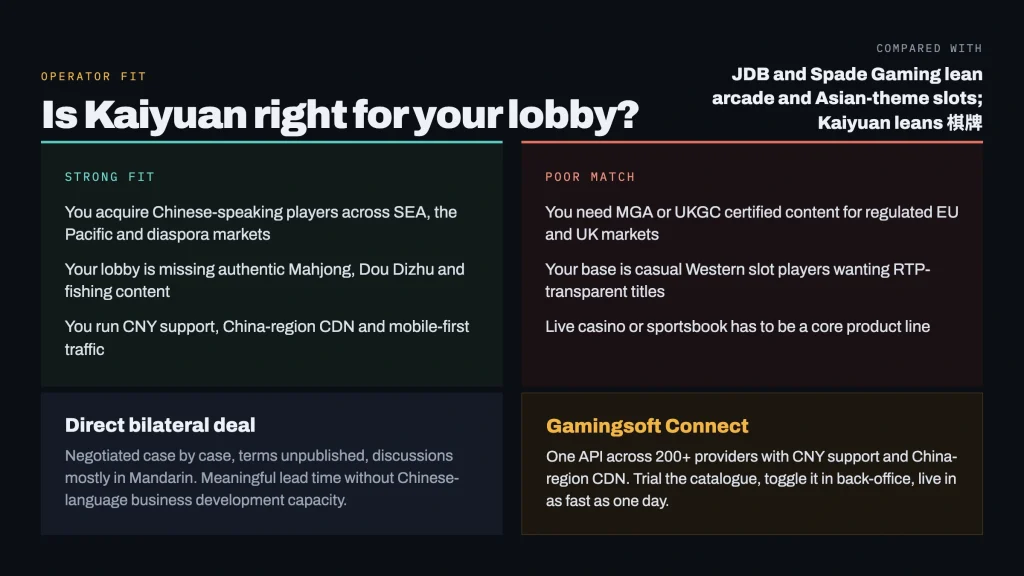
Kaiyuan is a strong fit for operators whose player acquisition strategy targets Chinese-speaking markets and who need authentic Chinese-format card game content that European studios don’t produce. The portfolio addresses player expectations around Mahjong, Dou Dizhu, and fishing games in formats those players actually recognise, filling a genuine content gap for most Western-built casino platforms entering the Chinese-speaking market.
The key condition is market alignment. Kaiyuan’s content performs in Chinese-speaking player segments. Operators whose player base is primarily Western-facing, who need RTP-transparent European slots for regulated UK or European markets, or who require live casino and sports products as primary offerings, will find Kaiyuan functions only as a narrow supplementary add-on at best.
Compared to JDB Gaming, which also covers fishing games and Asian arcade-style content, Kaiyuan’s catalogue is more heavily weighted toward traditional chess and card game formats (棋牌) rather than slot-adjacent arcade titles. Against Spade Gaming, which blends Asian themes with standard slot mechanics, Kaiyuan targets a more culturally specific card game audience rather than the broader Asian-aesthetic slot player segment. Neither comparison is a verdict; they’re different tools for different player profiles within the same broad market.
Operators who should evaluate alternatives first: those building for regulated European markets that require MGA or UKGC-certified content, those whose primary player base consists of casual Western slot players, or those who need live casino and sports as core product categories. Kaiyuan’s documented certification status in those frameworks is not publicly confirmed.
From a market angle, Kaiyuan fits naturally into operator strategies targeting Chinese-speaking communities across Southeast Asia, the Pacific region, and international markets. Gamingsoft’s infrastructure for those regions, including multi-language configurations, China-region CDN, and CNY payment support, makes the platform context a practical match for Kaiyuan’s content requirements. The broader vendor evaluation process is covered in how to evaluate casino software vendors.
Frequently Asked Questions
What type of games does Kaiyuan Gaming offer?
Kaiyuan Gaming focuses on traditional Chinese-format card and board games, fishing games, and electronic titles. Card games include Texas Hold’em in Chinese format, Mahjong, Dou Dizhu, Niu Niu, Baccarat, Pai Gow, and several others built to Chinese play conventions. Fishing games cover the fish-shooting arcade genre popular in Chinese-speaking markets. The studio doesn’t produce European-style RNG video slots, live casino content, or sports data products.
Is Kaiyuan Gaming suitable for startup operators targeting Chinese-speaking markets?
Yes, with the right access path. Startup operators who don’t have direct agreements with Chinese card game providers can access Kaiyuan’s catalogue through Gamingsoft Connect without negotiating a bilateral deal. That removes the language and relationship barriers that slow down direct provider discussions with Chinese-language-first studios, a real friction point for operators whose business development teams don’t operate in Mandarin.
Can operators access Kaiyuan Gaming without a direct deal?
Yes. Kaiyuan is available through Gamingsoft Connect alongside 200+ providers via a single API. Operators can trial the content and go live without establishing a separate direct agreement, and they can disable or enable the provider independently through the platform back-office without touching their core integration.
What currency does Kaiyuan Gaming support?
CNY (Chinese Yuan) is the primary listed currency for Kaiyuan on Gamingsoft’s platform (official, Gamingsoft provider listing). Operators building multi-currency environments should confirm additional currency support directly with the provider, as publicly available specifications focus on the CNY-facing market.
How does Kaiyuan Gaming compare to JDB Gaming for operators?
JDB Gaming covers fishing games and arcade-style slot content with a broader game type range that includes spinning-reel titles. Kaiyuan’s focus is more specifically on traditional Chinese chess and card formats (棋牌), which serve a different player behaviour pattern. Operators building for Chinese-speaking markets typically carry both types in their lobby rather than choosing between them, since the player segments overlap but don’t overlap completely.
Does Kaiyuan Gaming hold regulatory certifications for European markets?
Regulatory certification details for Kaiyuan Gaming are not publicly documented in English-language regulatory databases, including UKGC and MGA registers. Operators in jurisdictions requiring certified game content must verify compliance status directly with the provider before integration.
Who is Kaiyuan Gaming best for?
Kaiyuan is best suited to operators targeting Chinese-speaking player segments who need authentic Chinese card game content. Not Asian-themed versions of Western slots, but games built to actual Chinese card game conventions. It’s a poor fit for European-style slot lobbies, regulated UK/EU markets requiring MGA or UKGC certification, or operators whose primary player base doesn’t include Chinese-speaking players.
Kaiyuan Gaming solves a specific content problem for a specific operator profile. Platforms building for Chinese-speaking players without authentic card game content are handing those players a reason to go elsewhere; the studio is one of the few providers built from the ground up to fill that gap rather than approximate it.